


This memorial page is dedicated to Leslie Frank Adams, one of more than 725 war victims connected to the municipality of Deurne documented by Stichting Oorlogsslachtoffers. The municipality of Deurne and the surrounding villages of Liessel, Vlierden, Helenaveen, Neerkant and Zeilberg were liberated in the autumn of 1944 during heavy fighting. Victims fell on all sides: Allied soldiers from countries such as the United Kingdom, the United States, Canada and New Zealand, and German soldiers.
But the archive covers more than just the combat victims on Deurne soil. Residents of Deurne who lost their lives elsewhere are also commemorated: civilians who were murdered in concentration camps, forced labourers who died in Germany, people who were executed or succumbed to the effects of persecution and oppression. In addition, residents of Deurne who entered German military service and were killed elsewhere are also included.
Stichting Oorlogsslachtoffers has been documenting the story of all these people since 1995, without distinction of nationality, side or background. The goal is to give every person a name and a face, and to keep their memory alive.
| Name | : Adams | |
| First names | : Leslie Frank | |
| Nickname | : – | |
| Date of birth | : – | |
| Place of birth | : Birmingham | |
| Residence | : in Halesowen | |
| Rank / Occupation | : Gunner | |
| Identity tag | : 14388925 | |
| Unit | : Royal Horse Artillery, 13th (Honourable Artillery Company) Regiment. | |
| Date of death | : 24 April 1944 | |
| Place of death | : Deurne | |
| Cause of death | : – | |
| Cemetery | : Nederweert War Cemetery | |
| Memorial site | : Halesowen War Memorial (United Kingdom) | |
Additional information
Grave location: I. D. 8.
Aged 24. Awarded the Military Medal. Son of George and Kate Adams, of Halesowen, Worcestershire.
At around 14:00, the 2nd Fife and Forfar Yeomanry arrived in Deurne, which had by then been partially liberated, and rode on towards Bakel. C Squadron was ordered to carry out a reconnaissance mission at the Vlier near the Bakelseweg, but this upper course was overlooked by C Squadron and they rode on towards the Kaweische loop, which they believed to be the specified location. About 20 metres before the Kaweische Loop, the lead tank came into contact with a German armoured vehicle which had taken up a position in the Kaweide; soon, several German tanks, positioned in the Kuundert, also joined the battle.
Marinus van de Weijer, then a young man of 19, remembers it well. After the first lead tank took a direct hit, Marinus saw a British soldier leave the burning tank and jump into a ditch to extinguish his burning uniform. The second lead tank (about 50 metres behind the first tank), as well as the third tank – an observation post tank that had only just passed Marinus’s farm – were also taken out by the Germans. A fourth tank, under the command of Lieutenant E.A. Lamont, executed a flanking manoeuvre to the left and engaged the German tanks in the Kuundert but failed to take out a single German tank; nor did the British make any further progress that night.
Due to all the fighting around the farm, the family of ten spent the night with the Bankers family on Bruggenseweg. The following morning, Marinus and his brother returned to the farm to milk the cows; they had only just started their coffee when they were startled by British tanks driving across the fields and past the woods towards Bakel. The British fired a few shots in the direction of Bakel, but as the Germans did not ‘return’ fire, they advanced further towards Bakel.
Once things had calmed down somewhat, Marinus and his brother went to take a look at the tanks; when they reached the observation post tank, they opened the hatch and were horrified to find two dead British soldiers inside the vehicle. There were also two fatalities in the lead tank, the middle one, so the brothers decided not to go and look at the frontmost lead tank and returned home.
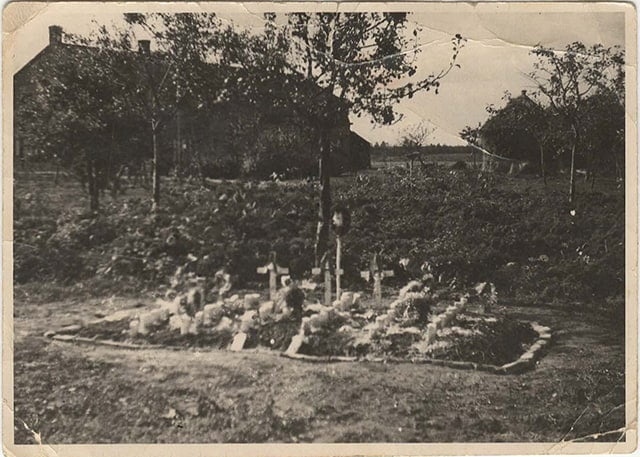
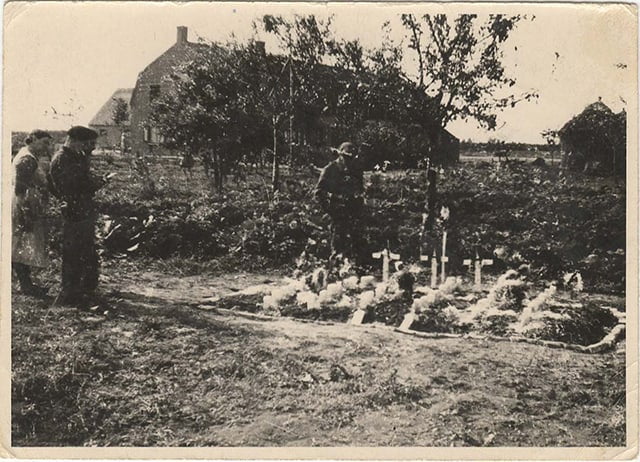
It was not until two days later, on 27 September 1944, that the British recovered the bodies of their fallen comrades from the tanks and buried them in a temporary grave near Marinus’s farm. Marinus still remembers the five war graves clearly, though he believes that two more British soldiers were buried here a little later.
During these battles, Thomas Paget and Frederick James Cornwall went missing.
Leslie Frank Adams, John Ogg, Alexander Forrester, Edward William Hodge and Clifford Colley lost their lives in these battles.
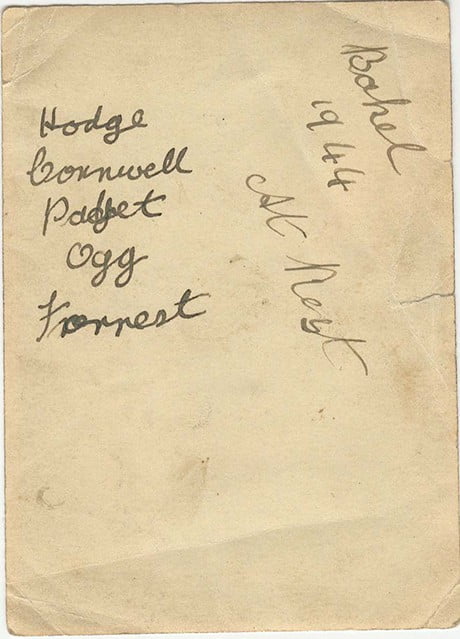
Below are the field graves, with the farmstead of Johannes M.F. van de Weijer, house number C.71 (now Hoefweg 3), in the background. Given the above, it is possible that Thomas Paget and Frederick James Cornwall were also buried here at the time. Although the text on the back of the photograph suggests otherwise – ‘Bakel 1944 At Rest Hodge Cornwall Paget Ogg Forrester’ – it can also be inferred from the photograph below that six people were buried here at the time.
httpv://youtu.be/Neaod7ww2sQ
View all persons in the category: Allied soldiers killed in action