


.
Photo: W.J. Staiger
.

| Surname | Bronny |
| First Name | Manfred |
| Nickname | Manfred |
| Rank | Not clearly established, see Military Career. |
| Alias Rank / Name | Captain Hamsey, Hq Co. 106 Div. |
| Born | 05.06.1920 Maserwitz, District Neumarkt (Silesia) |
| Died / Executed | 26.12.1944 in Henri-Chapelle (Belgium) |
| Burial Location . | Initial burial in Henri-Chapelle. On 11.02.1947 reinterred at the German War Cemetery Lommel (Belgium), Block 17 / Grave 422 |
| Identity Disc | -954- 3.Fla.Ers.Abt.33 [2] |
| Team Members | Hans Reich, Günther Schulz, Karlheinz Weisenfeld |
| Date & Place of Capture | 19.12.1944 between 21:00 – 22:00 hours in/near Liège (Belgium) |
| Decorations . | Iron Cross 2nd Class Luftwaffe Flak Battle Badge |
| Last Unit | Commando Company Panzer Brigade 150 |
| Father | Adolf Blasius Bronny, born in Timmendorf, Dist. Pless (Upper Silesia) |
| Nickname, Father | Adolf |
| Occupation, Father | Master Baker |
| Mother | Elisabeth Maria Bronny née Fau, born in Kreuzenort, Dist. Ratibor (Upper Silesia) |
| Nickname, Mother | Elisabeth |
| Occupation, Mother | Bookkeeper and interpreter |
.
NSDAP
In the Federal Archives in Berlin, only the membership of Adolf Bronny, the father of Manfred Bronny, could be established in the records of the former Berlin Document Center (BDC) in the NSDAP Gaukartei. The membership number is: 3452942.
Adolf Bronny had been a member of the NSDAP since 01.05.1934
Education
Manfred Bronny was sent by his parents to Berlin to complete an apprenticeship as a baker. Whether he finished or abandoned the apprenticeship could not be determined. The residents’ registration records of Berlin were largely lost due to wartime destruction, so written proof that Manfred Bronny lived in Berlin is lacking.
Family circumstances have meant that virtually no information about Manfred Bronny as a person has been found. The daughter of Adolf Bronny’s second wife knows details about Manfred Bronny only from stories told within the family. However, very little was spoken about this subject.
.

Manfred Bronny in civilian clothing. Source: Stichting Oorlogsslachtoffers.
| According to report dated 25.05.1940 | 3rd Battery Anti-Aircraft Replacement Battalion 33 |
| According to report dated 16.04.1940 | 3rd Battery Reserve Anti-Aircraft Battalion 304 |
| According to report dated 05.03.1941 | 3rd Battery Anti-Aircraft Replacement Battalion 33 |
| According to report dated 26.12.1944 | Panzer-Brigade 150 |
.
Note on Manfred Bronny’s Rank
According to a communication from the Deutsche Dienststelle dated 18.09.2009, Manfred Bronny’s rank was Wachtmeister. However, no promotion dates are known.
In her search request with the Red Cross, his mother also states “Wachtmeister” as his rank.
The death sentence, on the other hand, was passed against Feldwebel Manfred Bronny. It must be assumed that this was based on statements made by Manfred Bronny himself. The reason for the discrepancy in ranks will probably remain unclear forever.
No information is available regarding any hospital stays by Manfred Bronny.
.
The Family History
Adolf Bronny had to write down his professional career for his pension application. This list has been preserved and made available by family members. This list helps us today to reconstruct the family’s path.
From March 1926, Adolf Bronny was a self-employed baker in Karchowitz (Karchowice), located in what was then Upper Silesia (now Poland). In April 1929, the family emigrated to Vancouver, Canada. In Vancouver, Adolf Bronny was also the owner of a bakery. We also have an address: Vancouver B.C. (British Columbia), West Boulevard 6033, Canada. In the Canadian “Immigration Records” from the years 1925–1935 there are some documents about Manfred Bronny. These state that he arrived on 07.04.1929 from Hamburg, aboard the ship “St. Louis”, in Halifax, Canada.
Canadian archival records also show that Manfred Bronny travelled back to Germany in May 1939, via New York. Between September 1939 and December 1944, Adolf Bronny was interned in Canada and his bakery was confiscated.
.

Manfred Bronny with siblings and mother. The photo was most likely
taken in Canada, as the architectural style of the house suggests.
Source: Stichting Oorlogsslachtoffers.
.

Manfred Bronny (bleached hair) with his mother † and his sister †.
Source: Stichting Oorlogsslachtoffers.
.
The two siblings of Manfred Bronny appear in May 1936 on a passenger list to Liverpool, however without a parent.
Mrs. Bronny in Trouble
Until now, little was known about the individual family members beyond the emigration to Canada. That is now changing somewhat. A book passage appeared on the internet that brings to light a previously unknown episode from the family life of the Bronny family. An accompanying newspaper article also surfaced. This article apparently appeared in several newspapers but is identical in content.
Mrs. Bronny had to answer before a Canadian court in 1940 and served time in prison there. Archived letters corroborate the story. Since this event has nothing to do with Operation Greif, no Canadian documents — which certainly exist — were requested for this purpose.
Only a broad outline of events will be reported here.
The book “Adrift, Seven Canadian Women Travelling Through the Third Reich” *, written by Carolyn Gossage, deals with the odyssey of seven Canadian women through Nazi Germany. The women were passengers aboard the Egyptian steamship Zamzam. The steamship was sunk on 17 April 1941 by the German auxiliary cruiser Atlantis. The Canadian women were taken to Germany and later exchanged for nine German women. Six of these women are referred to as political prisoners. Among them is Elisabeth Bronny (together with her daughter). The story appears in various publications. The author cites several sources in her book that are easy to verify. The archive of the Foreign Office is one of the cited sources. There a correspondence is found between the Swiss Federal Political Department (Division for Foreign Interests) and the German legation in Bern. The letter initially concerns the criminal proceedings against Mrs. Bronny. A request is made that the Swiss consulate in Canada extend every possible assistance to Mrs. Bronny (letter dated 14 August 1940). A letter dated 7 August 1940 makes clear what Mrs. Bronny is accused of. In the letter to the German legation in Bern, the Federal Political Department writes, among other things, the following: “According to a communication from the special division of the Swiss legation in Great Britain dated 15 July 1940, the consul in Vancouver reported that Mrs. Bronny, the wife of a German national interned at Kananaskis, was sentenced by the County Court in Vancouver for being in possession of plans of the internment camp at Kananaskis, Alta, which had been drawn up by a German national who had previously been interned there. She was sentenced to 2 years imprisonment and a fine of $500. The aforementioned consulate recommended that Mrs. Bronny appeal this verdict, offering her the services of its trusted lawyer in case of need.“.
From the correspondence, conducted partly in English and partly in French, it emerges that there were originally several charges. Most of the charges were dropped; what remained was the charge of possessing the camp map of the camp in which her husband Adolf Bronny was held.
The charge was based on Section 16, Paragraph d. of the Defence of Canada Regulations (Defence of Canada Regulations).
A Canadian newspaper carried the following article on the matter.

Globe and Mail 1940
.
Vancouver Woman Faces Court, She Carried a Map of the Alien Camp.
Vancouver, June 16 (CP) –
Elisabeth Bronny was brought before the court on Saturday when she appeared at the police court in Richmond for a preliminary hearing on charges of violating the Defense of Canada Regulations.
Detective John K. Barnes of the Royal Canadian Mounted Police testified that police, during a search of Mrs. Bronny’s home on May 25, found a map of the alien internment camp at Kananaskis, Alta. He said the map was not drawn to scale but showed the general layout of the camp.
Further exhibits introduced included a pamphlet allegedly proving Mrs. Bronny’s membership in the German Nazi Party, and a photograph of the Kananaskis camp which, according to Sergeant Barnes, “had obviously been taken from a German-language newspaper printed somewhere in Canada.”
The pamphlet bore Mrs. Bronny’s signature and photograph and identified her as a member of the National Socialist German Workers’ Party, the full name of the Nazi organisation.
Ivan Ooshakoff, special agent of the R.C.M.P., testified that the pamphlet bore the emblem of the Nazi Party and the facsimile signature of Adolf Hitler.
On the first page, he said, were instructions in the German language: “Remember that wherever you are, you are a representative and member of the National Socialist Party and a member of our community.”
.
In the correspondence, the name of the Canadian woman to be exchanged for Elisabeth Bronny (together with her daughter) is mentioned. In a letter dated 4 April 1942, the name Phyllis Bosworth appears. Phyllis Bosworth had until then been interned at the Liebenau camp. Mrs. Bosworth does not appear on the passenger list of the Zamzam listed in the book. She also does not appear in the group photograph of the seven named Canadian women on the back cover of the book. Phyllis Bosworth, who was exchanged for Mrs. Bronny, therefore did not belong to the passengers of the Zamzam. The exchange, however, took place simultaneously. It is therefore more a matter of coincidence that Mrs. Bronny and her daughter found their way into the literature.
Mrs. Bosworth can be found in the Arolsen Archives and in the Canadian National Archives. The reason for her internment at the time was not investigated. According to a letter dated 10 April 1942, Mrs. Bronny stated that she wished to return to Germany. Where she went and what became of it does not emerge from the correspondence, which ends with that letter.
It can be documented that the mother was registered again in Germany from 1946 onwards. Her registration card stated that she had identified herself with an identity document from Ostrowo / Posen.
The identity document was issued on 26.05.1943 by the Landratsamt Ostrowo. There also exists a portrait photograph of her son Manfred, on the back of which is a stamp from a photographic studio in Ostrowo. It shows him with a young woman who has not yet been identified. It could not be clearly established whether the young woman is his sister. The siblings have been deceased for many years. Since the woman next to Manfred Bronny is not wearing glasses, family members have their doubts. However, we found indications that it could very well be his sister. Her first name is also written on the back. However, there are first names that occur more than once.
.
*In the original, The Accidental Captives: The Story of Seven Women Alone in Nazi Germany. By Carolyn Gossage.
.
Further Details on Manfred Bronny
It is truly pure luck that the last seven photographs still exist. A few months earlier, a household within the family had been dissolved and all photographs showing Manfred Bronny were destroyed, as nobody felt any connection to him. At that time we were still searching for family members but had hit a dead end in our research. By the time we picked up the trail again it was too late. We were informed that there were no longer any photographs of Manfred Bronny. When shortly afterwards we received word that a few photographs had been found while clearing out, and was asked whether we would like to have them, our joy was of course enormous. Lucky indeed!
Of the seven still-existing photographs, there are only a few clues. Only one photograph showing Manfred Bronny in German Luftwaffe uniform allows for a rough date, based on his decoration. The Luftwaffe Flak Battle Badge was instituted on 10 January 1941 by Hermann Göring (Commander-in-Chief of the Luftwaffe), so the photograph cannot have been taken any earlier than that date.
.

Manfred Bronny with company. Source: Stichting Oorlogsslachtoffers.
.
The Capture
The circumstances of the team’s capture can be read in the account of Lieutenant Günther Schulz.
From the estate of Sergeant W. J. Staiger, Comp. C of the 769th Military Police Battalion comes a very special photograph.
Sergeant Staiger took the photograph when the team was brought to the Military Police headquarters in Liège for interrogation.
.

On the way to interrogation; from right to left: K.H. Weisenfeld, M. Bronny, H. Reich (barely visible)
and still on the flatbed of the vehicle, G. Schulz. Photo, Sgt. Walter J. Staiger
.
|
|


.
Anyone who places the statements of L.M. Hansen, Staff Sergeant, also Comp. C of the 769th Military Police Battalion, alongside those of Frederich Wellach, First Lieutenant, G-2 Section First US Army, will conclude that the photograph was taken, with a fair degree of certainty, on 20.12.1944. Wellach certainly needed no more than a day to determine which of the four prisoners was most suitable as a source of information.
Once Wellach had separated the wheat from the chaff, it was certainly no longer necessary to transport the four together. Where the four were held between interrogations and the first trial (Bronny, Reich and Weisenfeld) is not known, though there is a prison in Liège that was operational at the time. Whether the four were held there, however, is uncertain.
Anyone wishing to know more about W. Staiger and his unit can look under “Personal Accounts.”
.
The Death Sentence


The death sentence against Manfred Bronny and his comrades as it appears in the Dachau trial file of Otto Skorzeny.
Source: BayHStA, Dachauer Kriegsverbrecherprozesse M1106
.

To the left of Manfred Bronny lies Karlheinz Weisenfeld. His grave is also decorated.
Source: Stichting Oorlogsslachtoffers.
.
Federal Archives Division PA, formerly Deutsche Dienststelle Berlin (WAST)
The existing personnel index cards* of the central personnel register for Manfred Bronny have now (March 2021) been personally examined by us.
According to a report dated 28.07.1945: Manfred Bronny has been listed as missing since 23.12.1944 in the Malmedy area. He had not returned from a special mission. Among the index cards there is also a letter** from his mother. The date is difficult to read, as a sticker bearing the name of the missing person has been placed over it. The date 20.05.1945 can be reconstructed, which also fits with the report dated 28.07.1945. The addressee is the Hauptamt für Gefallene und Vermisste in Berlin (Tempelhof), Jüterborg Str. Barracks. Mrs. Bronny informs them that her son, Wachtmeister Manfred Bronny, has been listed as missing in the West since 23.12.44.
His last known address was (13a) Alt Neuhaus, via Vielseck, Oberpfalz, Unit Stielau.
The mother then quotes a letter she had received.
The sender of the letter is stated as: Panzer Brigade 150 Commando Company.
Mrs. Bronny quotes the content of the communication as follows: In the course of combat operations on 23.12.44, within the framework of a special unit to which your son also belonged, Wachtmeister Bronny was entrusted with a mission. He has not returned since. We suspect that he fell into enemy hands.
Signed Lorenz
Major and Commando Commander
*/**Signature see Sources
Information from the International Red Cross (ICRC) in Geneva
(International Committee of the Red Cross, ICRC)
The still-existing search request at the Red Cross in Geneva shows that Manfred Bronny had been listed as missing since 23.12.1944. According to the search request dated 07.07.1946, his mother stated that her son Manfred had been assigned to Panzer-Brigade 150.
The death certificate was registered at the Red Cross in Geneva under: RAD 96518.
The certificate differs only marginally in its details from the certificate of Günther Billing.
Here too, the details regarding the capture are missing. On this certificate the unit is listed with the addition Panzer-Brigade 150.
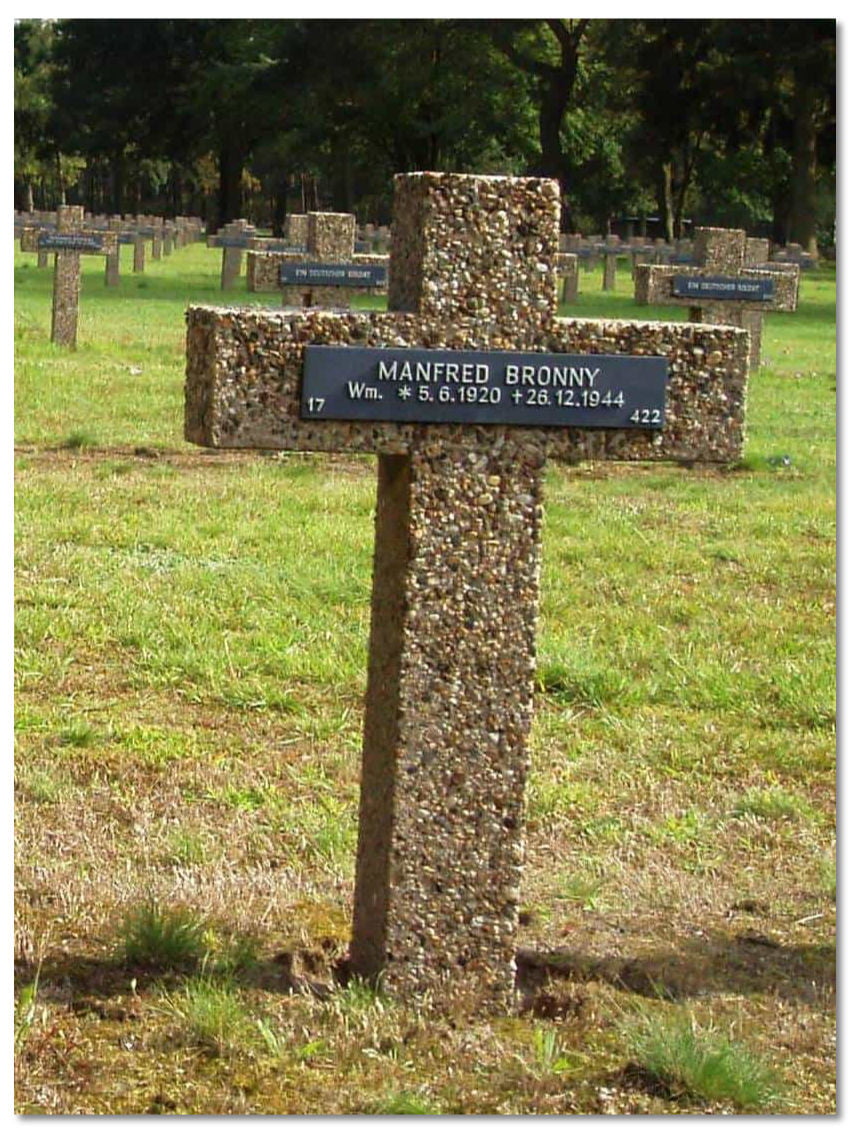
German Military Cemetery Lommel, Belgium. Photo: © Stichting Oorlogsslachtoffers.
Other commando soldiers of Operation Greif: Günter Joachim Billing, Horst Ernst Görlich, Arno Krause, Rolf Meyer, Erhard Emil Miegel, Manfred Franz Joachim Pernass, Robert Martin Emil Pollack, Hans Walter Otto Reich, Günther Rudolf Schilz, Wolfgang Egon Herbert Schmidhuber, Wilhelm Schmidt, Günther Ernst Heinz Schulz, Otto Richard Struller, Erich Heinrich Wedel, Karlheinz Wilhelm Weisenfeld, Hans Dietrich Wittsack