


This memorial page is dedicated to Adrianus Vogels, one of more than 725 war victims connected to the municipality of Deurne documented by Stichting Oorlogsslachtoffers. The municipality of Deurne and the surrounding villages of Liessel, Vlierden, Helenaveen, Neerkant and Zeilberg were liberated in the autumn of 1944 during heavy fighting. Victims fell on all sides: Allied soldiers from countries such as the United Kingdom, the United States, Canada and New Zealand, and German soldiers.
But the archive covers more than just the combat victims on Deurne soil. Residents of Deurne who lost their lives elsewhere are also commemorated: civilians who were murdered in concentration camps, forced labourers who died in Germany, people who were executed or succumbed to the effects of persecution and oppression. In addition, residents of Deurne who entered German military service and were killed elsewhere are also included.
Stichting Oorlogsslachtoffers has been documenting the story of all these people since 1995, without distinction of nationality, side or background. The goal is to give every person a name and a face, and to keep their memory alive.

| Name | : Vogels | |
| First names | : Adrianus | |
| Nickname | : – | |
| Date of birth | : 31 January 1877 | |
| Place of birth | : Nistelrode | |
| Residence | : Langstraat E.73, Deurne | |
| Rank / Occupation | : Farmer | |
| Identity tag | : – | |
| Unit | : – | |
| Date of death | : 24 December 1944 | |
| Place of death | : Helmond | |
| Cause of death | : as a result of a burst from a ship’s gun | |
| Cemetery | : – | |
| Memorial site | : – | |
Additional information
Son of Jan Vogels and Wilhelmina van den Bogaart, widow of Antonia Kuijpers.
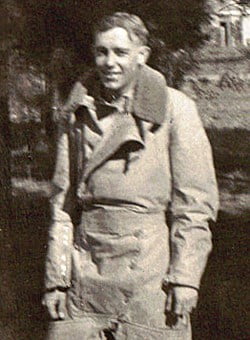
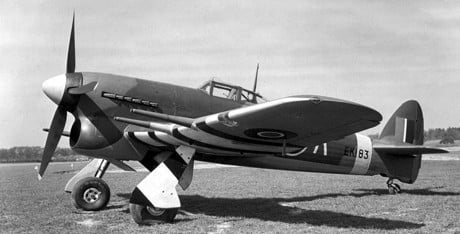
On 24 December 1944, Squadron Leader J.H. Deall (see photo below), commander of No. 266 Squadron, made an emergency landing on Nachtegaalweg with his Hawker Typhoon IB following fire from German anti-aircraft guns (FLAK). As a result of this incident and the event described below, Adrianus Vogels and Antoon Theodor Thielen – two more men – lost their lives. Janus Nooijen and Hendrik Bellemakers were injured in the process. Squadron Leader J.H. Deall described in his own words what happened that day, as recounted by the pilot, and recorded this in his diary. The Dutch translation and some corrections or additions to this account can be found below.*
“Early on Christmas Eve morning 1944, I set out from Antwerp in a pair with Flight Sergeant Morgan flying as my number two, to look for opportunity targets in the frontline area. We soon found a military convoy which we proceeded to strafe, receiving in return the usual fierce response. I was hit in the oil and coolant radiators and my number two reported that I was trailing smoke.
I reduced the power to minimum revs and headed for friendly territory, now of course only able to fly very slowly, but keeping up a weaving manoeuvre and flying as low as possible. My number two, bless him, stayed with me, sharing the anti-aircraft fire that came at us for quite a few miles, the area obviously being well defended. Not long after regaining friendly territory, my engine cut out. It had performed remarkably well to last so long. Fortunately, ahead lay a series of large polders divided by the usual tree-lined embankments. I landed in the first one, pulling down a telephone line at the threshold. The touchdown was quite smooth, but as the ground was completely frozen, the aircraft skidded along seemingly endlessly until at last it hit the tree-lined embankment, bounced between two trees and came to rest on a road.
I was unharmed and greatly relieved to have landed safely. Looking out, I saw the road was lined with white tape, and tied to the nearest tree was a notice reading ‘Clear of mines.’ I was even more relieved. I called my co-pilot to say all was well. He called out, “Well done,” and headed home. I switched everything off and got out to assess the damage. An elderly Dutch man cycled up. He managed to make me understand that I should take his bike and seek help from an army camp further up the road whilst he stayed with my aircraft. I thanked him and set off on the bike, finding the army headquarters two or three miles away. They kindly gave me a whisky and milk—it was a freezing morning. After some breakfast, they took me and the bike back to the aircraft.
There we found quite a crowd of locals gathered round the aeroplane, and to my great distress I saw a figure covered in a blanket lying in front of the starboard wing. A young girl, who was the local doctor’s daughter, spoke good English and told me what had happened. It seems that a young man had got into the cockpit, ignoring the protests of my elderly assistant, had strapped on my parachute and put on my flying helmet. He must have been fiddling with the switches and controls, but eventually he selected and pressed a firing button, causing two of the 20mm cannons to fire, killing the old man who had been standing in front of the aircraft.
The young girl was wonderful and consoled and comforted me, as did the crowd, which helped me a great deal. A guard was posted and I was taken away from the tragic scene to the nearest Air Force Base, where the necessary reports were made. I then travelled by road back to Antwerp, arriving at dusk."
Translation…
"In the early morning of Christmas Eve 1944, I took off from Antwerp, together with Flight Sergeant Morgan, who was flying as my wingman in another aircraft, in search of potential targets in the frontline area. We soon found a military convoy which we opened fire upon; in return, we received the usual retaliation. As a result, I was hit in the oil and coolant radiators, and my number two reported that I was leaving a trail of smoke.
I reduced speed to minimum power and set course for friendly territory; naturally, I was only able to fly slowly, but I remained airborne and as low as possible. My number two, thank goodness, stayed close by and shared the FLAK (anti-aircraft fire) that hit us for a few more miles; the area was apparently well defended. Shortly after regaining friendly territory, the aircraft’s engine failed. It had performed remarkably well to have lasted so long. Fortunately, we came across a series of polders divided by the usual embankments lined with rows of trees. I landed in the first one, snagging a telephone cable as I touched down on the edge of the embankment. The landing went quite smoothly, but as the ground was completely frozen, the aeroplane skidded seemingly endlessly until it finally slid against the embankment by the line of trees and came to a halt on the road between two trees.
I was unharmed and relieved to be safely on the ground. Looking out, I saw that the road had been marked with white tape and attached to the nearest tree was a note reading ‘mine-free’. I was now even more relieved. I reported to my co-pilot that everything was fine. He replied, ‘Good job’, and flew back home. I switched everything off and left the aircraft to assess the damage. An elderly Dutchman cycled towards me. I realised he was going to give me his bike so that I could go and ask for help at an army camp further down the road, whilst he would stay with my aeroplane. I thanked him and set off on his bike towards the military headquarters, three to five kilometres away. When I arrived, they gave me whisky with milk – it was a freezing cold morning. After breakfast, they took me and the bike back to the aeroplane.
There we found a crowd of people gathered round my aeroplane and, to my great sorrow, I saw a man lying under a white sheet in front of the starboard wing. A young girl, the daughter of the local GP, spoke good English and told me what had happened. It seemed that a young man, despite my older helper’s protests, had gone into the cockpit, put on my parachute and donned my helmet. He must have been fiddling with the switches and push-buttons and eventually pressed the firing button, causing two of the 20mm on-board cannons to fire and fatally strike the older man, who was standing in front of the aeroplane.
The young girl was admirable; she reassured me and comforted me, just as the crowd also helped me tremendously. A guard was posted at the aeroplane and I was taken away from this sad scene and brought to the nearest Air Force base, where the necessary reports were drawn up. I then travelled back to Antwerp by road, arriving at dusk.”
*Most of the bystanders were local residents who were on their way home after the church service and, prompted by the incident described above, went to look at the plane wreckage, just like Antoon Theodor Thielen, who cycled quickly to the scene. According to eyewitnesses, however, it turned out not to be a young man who had crawled into the aeroplane, but 58-year-old Cornelis van der Linden. Janus Nooijen soon decided to call it a day and was on his way home again when he was struck by the volley of fire from a considerable distance. The young girl the pilot wrote about was Carla Verhaegen, daughter of the then GP, Remy Verhaegen. Had the aeroplane’s landing gear not broken off – and the aeroplane consequently been at a different angle – the above-mentioned tragedy might not have occurred.
Squadron Leader J.H. Deall
Typhoon IB
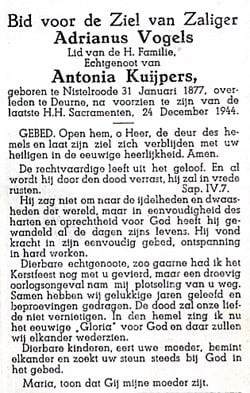
Memorial card
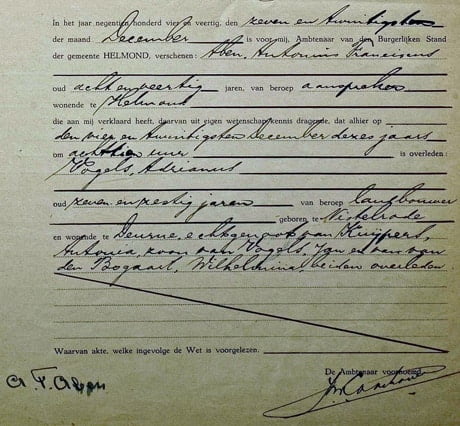
Death register
View all persons in the category: Residents of Deurne who died outside Deurne