


This memorial page is dedicated to Cornelis Nicolaas Schrama, one of more than 725 war victims connected to the municipality of Deurne documented by Stichting Oorlogsslachtoffers. The municipality of Deurne and the surrounding villages of Liessel, Vlierden, Helenaveen, Neerkant and Zeilberg were liberated in the autumn of 1944 during heavy fighting. Victims fell on all sides: Allied soldiers from countries such as the United Kingdom, the United States, Canada and New Zealand, and German soldiers.
But the archive covers more than just the combat victims on Deurne soil. Residents of Deurne who lost their lives elsewhere are also commemorated: civilians who were murdered in concentration camps, forced labourers who died in Germany, people who were executed or succumbed to the effects of persecution and oppression. In addition, residents of Deurne who entered German military service and were killed elsewhere are also included.
Stichting Oorlogsslachtoffers has been documenting the story of all these people since 1995, without distinction of nationality, side or background. The goal is to give every person a name and a face, and to keep their memory alive.

| Name | : Schrama | |
| First names | : Cornelis Nicolaas | |
| Nickname | : Cor | |
| Date of birth | : 7 June 1909 | |
| Place of birth | : Wassenaar | |
| Residence | : C.23 in Bakel and Milheeze | |
| Rank / Occupation | : Farmer | |
| Identity tag | : – | |
| Unit | : – | |
| Date of death | : 31 January 1944 | |
| Place of death | : Helmond | |
| Cause of death | : as a result of a gunshot wound | |
| Cemetery | : Roman Catholic Cemetery at Brouwhuis-Rijpelberg | |
| Memorial site | : St Joseph’s Memorial Chapel in Helmond | |
Additional information
Son of Gerardus Schrama and Maria de Jong, widow of Johanna Maria Boudewijns.
On the afternoon of Sunday 30 January 1944, a Boeing B-17 F bomber, nicknamed ‘Martha the II’ and bearing the serial number 42-29761 (VP-W), was forced to make an emergency landing in ‘de Rakt’ near Deurne. During a mission to Braunschweig (Germany), this bomber was shot down by several German Focke-Wulf 190 fighter aircraft before it reached its target. Harold Arthur Holtz, Wilbert Everett Eason, Harry Fong Lee and Peter Hlynsky lost their lives in the incident. Wilbert Everett Eason managed to jump out of the aircraft in time, but his parachute failed to open. Peter Hlynsky had also jumped from the aircraft but broke his neck during the jump; he asked some civilians who had rushed to the scene for a priest, and before he died from his injuries, he was administered the last rites.
Staff Sergeant Perry E. Beach survived the emergency landing but was soon taken prisoner by the Germans whilst fleeing. 1st Lieutenant Henri D. Steele, 2nd Lieutenant James R. Settle, 2nd Lieutenant Robert F. Anderson, 2nd Lieutenant Leopold L. Flores and Sergeant Paul Oakly Welch also survived this emergency landing but, after spending some time in hiding, were taken prisoner by the Germans in Brussels on 19 and 20 March.
A day later, during a German search operation for the aircraft’s crew, Cornelis Nicolaas Schrama was shot 200 metres from his family home on Rakt B.41. The Germans most likely mistook him for a crew member; he died of his injuries that very same day in hospital in Helmond.
Official Report
“On 31 January 1900, at approximately 2.00 pm, I, Johannes Hendricus van den Heuvel, Sergeant Major of the Military Police belonging to the Deurne Military Police Group, Vlierden Post, walking along the road leading from Guard Post 28 to the Deurne–Helmond road, near Vlierden in the municipality of Deurne, at a place known as ‘Rakt’. At the aforementioned time, I heard a gunshot on the road on which I was travelling. I was approximately 500 metres away from it at the time.
I then dismounted from my bicycle and shortly afterwards I heard another shot or two. All the shots came from the direction of the Deurne–Helmond road near Vlierden. At the same time, I saw two people on the Deurne–Helmond road making some gestures, and at the same time I heard a scream, immediately after which those people also fell onto the road. When I saw this, I was only 200 to 300 metres away from the spot where the people had fallen. I cycled straight towards these people. Before I reached the injured, German soldiers came running out of the field from the north, most of them carrying rifles. Some of these soldiers had already reached the people involved before I did, but whilst I was standing there for a few moments, an estimated 20 to 25 German soldiers arrived at the scene. At the moment the individuals fell, there were no other people at the scene. However, a few moments later, some cyclists arrived at the scene, coming from the direction of Helmond.
Of the two people who had been hit, I recognised one as Cor Schrama; the second person I recognised as someone who usually works for Schrama’s parents, and who later turned out to be called Kuijpers. Upon examining Schrama’s clothing, I noticed that he had a bleeding wound on his right side, judging by the large amount of blood on his clothes in that area and the torn fabric there; Kuijpers had a deep, bleeding wound on his right forearm. A few moments later, a luxury car arrived from the direction of Helmond; I asked the driver to take the victims to Helmond Hospital, which he did. This was a car belonging to the Carp company in Helmond.
During the journey, Schrama told me the following in response to my question, ‘How are you, Schrama?’: ‘The Germans have shot me.’ Schrama was still fully conscious when he told me this. Kuijpers had also heard this and confirmed it to me. Once both victims were at the hospital, Schrama told me again that the Germans had shot him, but he could not say from which direction the shot had come. Kuijpers made the following statement in hospital: “This afternoon, at approximately 1.30 to 2.00 pm, I was cycling with Cor Schrama along the Deurne–Helmond road in the municipality of Deurne. We were cycling towards Deurne, having come from Cor Schrama’s house in the direction of Helmond. Suddenly, I heard two shots. I cannot say from which direction they came. At the same time, I saw blood running down my right hand and, almost immediately afterwards, I fell onto the road. Schrama then said to me, ‘The Germans have shot me’. At the moment I was hit, I did not see any Germans on the left-hand side of the road (this is the area where I saw the German soldiers whilst the shooting was taking place. Statement-taker). I did not hear anyone shout ‘halt’ or anything similar. My attention was drawn to the area where a crashed aeroplane lay. (This is the area to the right of where Kuijpers was standing. Statement-taker). The casualties whom I transported to the hospital were immediately given medical and psychological assistance there. Dr Brandhorst in Helmond treated both of the injured men. However, Schrama died that very afternoon at around 3.30 pm.
The victims are named as follows:
1. Cornelis Nicolaas Schrama, born in Wassenaar on 7 June 1909, Dutch, a farmer with residence at Bakel, municipality of Bakel and Milheeze, C No. 23. 2nd. Wilhelmus Franciscus Kuijpers, born in Helmond on 9 December 1912, a woodworker with residence at Beelstraat No. 11, Helmond. A Dutch national from birth.
Although I did not question the German soldiers present at the scene, in accordance with regulations, one of the soldiers who had transported the victims to the hospital told me the following at the hospital when I remarked that it was not my job (I meant shooting those people): ‘“Halt” was called out’ – at least, as far as I could make out, those were the words spoken by that soldier.
Pending further instructions, I have provisionally seized Schrama’s body. At the request of the German soldiers, both injured persons have been placed under guard, and this request has been complied with. My Group Commander, like myself, immediately contacted the Ortskommandant of Eindhoven and the Feldgendarmerie there, both of whom promised to come. That very evening, my Group Commander informed the Feldgendarmerie that Schrama had died. The Feldgendarmerie then stated that they would provide guidance the following morning, 1 February 1944, on how to proceed. My Group Commander informed the Public Prosecutor of these developments, who had stated that further instructions from the German authorities were awaited.
In witness whereof, having taken the oath of office, this official report was drawn up, signed and sealed at Deurne Vlierden on 1 February 1944.”
Photographs of the actual aircraft; see also its nickname “Martha the II” and tail number 229761.


Sergeant Paul Oakly Welch *3 September 1922 †27 February 2007, who survived the crash.

Jan van de Westerlo wearing the flight uniform of Paul Oakly Welch, which was kept out of the hands of the Germans by Peter van de Westerlo (Jan van de Westerlo’s father).

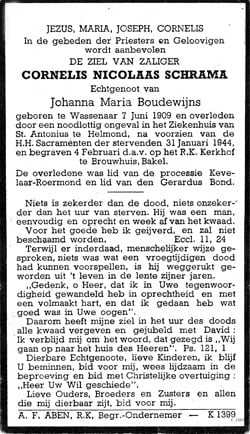
Memorial card
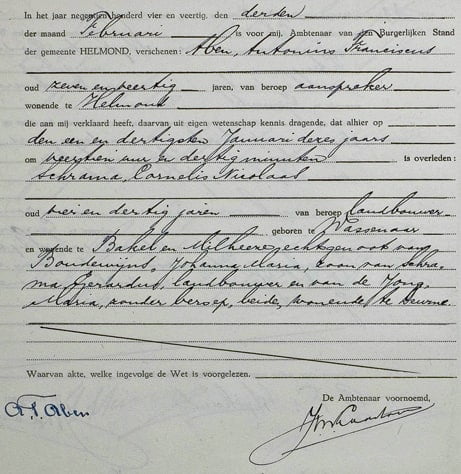
Death register
View all persons in the category: Residents of Deurne who died outside Deurne