


This memorial page is dedicated to Donald Alexander McFayden, one of more than 725 war victims connected to the municipality of Deurne documented by Stichting Oorlogsslachtoffers. The municipality of Deurne and the surrounding villages of Liessel, Vlierden, Helenaveen, Neerkant and Zeilberg were liberated in the autumn of 1944 during heavy fighting. Victims fell on all sides: Allied soldiers from countries such as the United Kingdom, the United States, Canada and New Zealand, and German soldiers.
But the archive covers more than just the combat victims on Deurne soil. Residents of Deurne who lost their lives elsewhere are also commemorated: civilians who were murdered in concentration camps, forced labourers who died in Germany, people who were executed or succumbed to the effects of persecution and oppression. In addition, residents of Deurne who entered German military service and were killed elsewhere are also included.
Stichting Oorlogsslachtoffers has been documenting the story of all these people since 1995, without distinction of nationality, side or background. The goal is to give every person a name and a face, and to keep their memory alive.
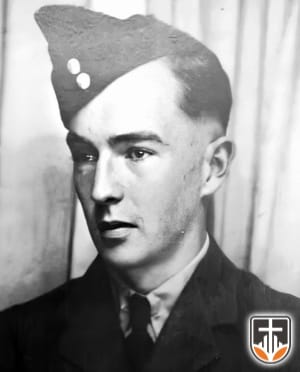
| Name | : McFayden | |
| First names | : Donald Alexander | |
| Nickname | : – | |
| Date of birth | : 20 October 1923 | |
| Place of birth | : Fort Frances, Ontario (Canada) | |
| Residence | : – | |
| Rank / Occupation | : Pilot Officer (Air Gunner) | |
| Identity tag | : J/94252 | |
| Unit | : Royal Canadian Air Force, 50 (R.A.F.) Squadron | |
| Date of death | : 21 February 1945 | |
| Place of death | : Helenaveen | |
| Cause of death | : as a result of a plane crash | |
| Cemetery | : Groesbeek Canadian War Cemetery | |
| Memorial site | : | |
Additional information
Grave location: XV. F. 9.
Aged 21. Son of Archibald McFayden and Pearl Elizabeth McFayden of Fort Frances, Ontario (Canada).
He was posted to No. 50 Squadron at RAF Skellingthorpe in Lincolnshire, together with the rest of the crew with whom he flew on that fateful night.
- Pilot; Flying Officer Peter Gordon Anderson
- Flight Engineer; Sergeant Denys William Lewis
- Navigator: Flight Sergeant Roy Campbell
- Air Bomber; Flight Sergeant Denis Alphonsus McCauley
- Wireless Operator/Air Gunner: Flight Sergeant Ward Rex Southcott
- Air Gunner (Middle); Flight Sergeant Donald Alexander McFayden
- Air Gunner (Rear); Sergeant Fred Seddon Langton
That evening, at 17:02, they took off from RAF Skellingthorpe in an Avro Lancaster I (VN-X) with serial number LL741, named ‘Expectant’. This was a Mark 1 which had been delivered to 50 Squadron in 1943 and had already completed 92 operations by 1945. They flew alongside approximately 165 Lancasters and 12 Mosquitos in an attempt to breach the Mittelland Canal near Gravenhorst. The mission was successful, with reports stating that the target had been rendered completely unusable. However, 13 Lancasters were lost, with 53 crew members killed, 19 taken prisoner and 11 escaping.
LL741 managed to drop fourteen 1,000-pound bombs over enemy territory at 20:37 from an altitude of approximately 10,000 feet. During the bombing run, it was hit, presumably by anti-aircraft fire. According to witnesses, however, all four engines were still running when the Lancaster began its return journey.
At around 09:15, as the aircraft approached Deurne at 7,000 feet, it was attacked by a German night fighter, presumably Hauptmann Heinz Rokker of 2./NJG2 (Nachtjagdgeschwader 2).
Peter Gordon Anderson ordered the crew to abandon the aircraft. Denys Lewis walked towards the forward emergency hatch when he saw that Denis Alphonsus McCauley was also preparing to jump. Both crew members left the aircraft, but it turned out that Denis Alphonsus McCauley’s parachute was on fire, causing him to fall to his death. The rest of the crew, including Fred Seddon Langton, were unable to escape the aircraft and were killed when it crashed. Denys Lewis injured his right leg on landing and spent the night wrapped in his parachute, trying to sleep. He was found by two Dutch soldiers, as he had landed in the part of the Netherlands that had already been liberated. He returned to England and resumed operations in April 1945.
On the morning of 22 February 1945, rescue and recovery teams, comprising ground crew members (volunteers), were dispatched to search for three Lancaster bombers that had crashed in the area the previous night. They found the remains of LL741 in Helenaveen, and the wrecks of the other two Lancaster bombers in Weert and Ysselsteyn. Eight bodies recovered from the three wrecks were buried with full military honours the following day at ‘De Oude Toren’ Cemetery in Woensel, including those of Fred Seddon Langton and Denis Alphonsus McCauley. Roy Campbell, Peter Gordon Anderson and Ward Rex Southcott were buried at the Canadian War Cemetery in Groesbeek. A day later, on 24 February, the body of Donald Alexander McFayden was recovered. He was also buried at the Canadian War Cemetery in Groesbeek on 27 February.
In 1947, the remains of Fred Seddon Langton and Denis Alphonsus McCauley were reinterred at Overloon War Cemetery.
Commemorated on page 542 of the book “Second World War Book of Remembrance”
Hauptmann Heinz Rokker
View all persons in the category: Allied soldiers killed in action