


This memorial page is dedicated to Franciscus Coolen, one of more than 725 war victims connected to the municipality of Deurne documented by Stichting Oorlogsslachtoffers. The municipality of Deurne and the surrounding villages of Liessel, Vlierden, Helenaveen, Neerkant and Zeilberg were liberated in the autumn of 1944 during heavy fighting. Victims fell on all sides: Allied soldiers from countries such as the United Kingdom, the United States, Canada and New Zealand, and German soldiers.
But the archive covers more than just the combat victims on Deurne soil. Residents of Deurne who lost their lives elsewhere are also commemorated: civilians who were murdered in concentration camps, forced labourers who died in Germany, people who were executed or succumbed to the effects of persecution and oppression. In addition, residents of Deurne who entered German military service and were killed elsewhere are also included.
Stichting Oorlogsslachtoffers has been documenting the story of all these people since 1995, without distinction of nationality, side or background. The goal is to give every person a name and a face, and to keep their memory alive.

| Name | : Coolen | |
| First names | : Franciscus | |
| Nickname | : Frans | |
| Date of birth | : 2 May 1916 | |
| Place of birth | : Deurne | |
| Residence | : 26 Zandbosweg, Deurne | |
| Rank / Occupation | : Soldier / factory worker | |
| Identity tag | : – | |
| Unit | : Machine-gun Company, 2nd Battalion, 2nd Infantry Regiment | |
| Date of death | : 12 May 1940 | |
| Place of death | : Tilburg East, Bosscheweg | |
| Cause of death | : killed whilst jumping from railway and road bridges | |
| Cemetery | : Grebbeberg Military Cemetery in Rhenen | |
| Memorial site | : War Memorial at St Willibrord’s Church in Deurne | |
| : ‘De Brabantse Soldaat’ Provincial Memorial in Waalre | ||
Additional information
Grave location: Row 11 / Grave 6
Son of Theodorus Johannes Coolen and Antonia Adriana van Gog.
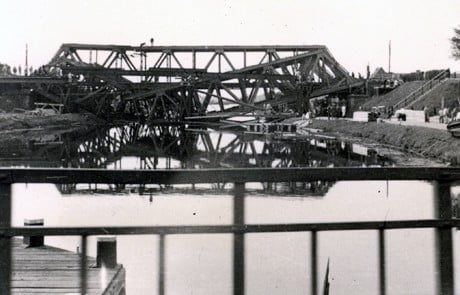
All the bridges were blown up, with those over the Wilhelmina Canal being the most prominent (see photo below). It is also clear that all this took place south-east and east of Tilburg.
Franciscus Coolen was reportedly killed on 11 May 1940 during the fighting on the Bredaseweg in front of the entrance to what was then the Dierenpark, and was not found until 14 May 1940. The cause of death therefore appears to have been determined retrospectively; he must have gone missing en route and was eventually recovered.
II-2.RI was stationed near Uden in the Peel-Raam defences and withdrew to the Zuid-Willemsvaart around midnight on 10 May 1940, moving into 11 May 1940. If Francisicus Coolen was already near Tilburg at 03:00 on 11 May 1940, then he was either on a special mission or had fled. The rest of II-2.RI did not withdraw from the Zuid-Willemsvaart defences towards Tilburg until around 4.00 pm on 11 May 1940. The first units to reach the vicinity of Tilburg were a few advance parties. According to a report by one of them, three of their number were killed in a bombing raid by several German aircraft near Tilburg on the morning of 11 May 1940, along with two Frenchmen, who were killed instantly at the level crossing. That was Bernardus Gerardus van Vorle, who was killed in action on 11 May 1940 near Burgers Zoo in Tilburg. An ‘unknown’ soldier had both legs severed there, and a sergeant was hit in the head by shrapnel. A corporal from 1-III-26th Infantry Regiment, Josef Antoon Smolders, was also killed in action.
However, three men from MC-II-2nd Infantry Regiment were hit near the bridges on the Boscheweg: conscripts Johannes Hendrikus Beurskens, Franciscus Coolen and Gerardus Schoenmakers. As Johannes Hendrikus Beurskens and Gerardus Schoenmakers are also recorded as having ‘perished when the railway and road bridges were blown up’, Franciscus Coolen presumably did not die on 11 May 1940 but on 12 May1940, and indeed, together with Johannes Hendrikus Beurskens and Gerardus Schoenmakers, on the Boscheweg as a result of the bridge being blown up prematurely. This would also explain why Franciscus Coolen was not in Tilburg at 03:00 on 11 May 1940 at all, which would have been impossible unless he had fled. More importantly, a bridge is blown up only once, and at 03:00 on 11 May 1940, the French did not blow up any bridges; on the contrary, they prevented the Dutch from doing so prematurely. With our entire Peel Division positioned east of Tilburg, blowing up bridges was not yet on the agenda. That did not happen until the early evening, night and morning of 12 May 1940.
It is therefore likely that Franciscus Coolen was killed on 12 May 1940, together with Johannes Hendrikus Beurskens and Gerardus Schoenmakers, when the bridge on Bosche Weg was blown up. He therefore had nothing to do with those killed near the zoo, although the distance between the Bossche Weg and the Bredase was not that great, of course. It is more likely that three men from the same unit were killed in a single incident and described in a single account, whilst another account concerning the zoo was found in a report and attributed to a German air raid.
On 17 June 1940, Theodorus Johannes Coolen submitted a request to the mayor of Tilburg to have the remains of Franciscus Coolen exhumed and transferred to the Roman Catholic Cemetery in Deurne. On Wednesday 19 June 1940, Mayor Lambooy, amongst others, laid a wreath at Franciscus Coolen’s original grave in the ‘Vredehof’ public cemetery (Section B) on Gilzerbaan in Tilburg. Following the wreath-laying ceremony, the remains were transferred to Deurne, from where they were reburied on 19 May 1980 to their final resting place, the Grebbeberg Military Cemetery in Rhenen. (4 | 36)
Memorial card

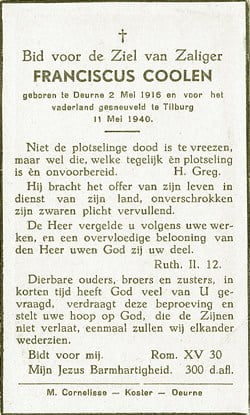
Joint memorial card

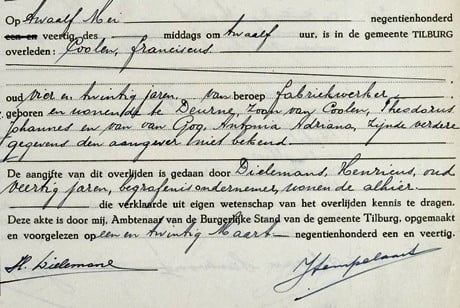
Death register
One of the bridges blown up across the Wilhelmina Canal
View all persons in the category: Dutch Soldiers Killed in Action