


This memorial page is dedicated to Jan Bremer, one of more than 725 war victims connected to the municipality of Deurne documented by Stichting Oorlogsslachtoffers. The municipality of Deurne and the surrounding villages of Liessel, Vlierden, Helenaveen, Neerkant and Zeilberg were liberated in the autumn of 1944 during heavy fighting. Victims fell on all sides: Allied soldiers from countries such as the United Kingdom, the United States, Canada and New Zealand, and German soldiers.
But the archive covers more than just the combat victims on Deurne soil. Residents of Deurne who lost their lives elsewhere are also commemorated: civilians who were murdered in concentration camps, forced labourers who died in Germany, people who were executed or succumbed to the effects of persecution and oppression. In addition, residents of Deurne who entered German military service and were killed elsewhere are also included.
Stichting Oorlogsslachtoffers has been documenting the story of all these people since 1995, without distinction of nationality, side or background. The goal is to give every person a name and a face, and to keep their memory alive.

| Name | : Bremer | |
| First names | : Jan | |
| Nickname | : – | |
| Date of birth | : 16 January 1920 | |
| Place of birth | : Helenaveen | |
| Residence | : H 93, Helenaveen | |
| Rank / Occupation | : Casual labourer | |
| Identity tag | : Prisoner number 24601 | |
| Unit | : – | |
| Date of death | : 22 March 1945 | |
| Place of death | : Salzgitter-Hallendorf (Germany), Camp 21 | |
| Cause of death | : as a result of exhaustion and malnutrition | |
| Cemetery | : Dutch War Cemetery in Hanover (Germany) | |
| Memorial site | : War memorial in Helenaveen | |
Additional information
Son of Aaldert Bremer and Antje Prijs, widow of Geertruida Prijs.
Grave location: Section G / Grave 28
On Sunday 8 October 1944, during the 7.00 am Mass, German paratroopers (Fallschirmjäger) surrounded the two Rijkswerkkampen I and II in Mariaveen. The people were driven out of the chapel during Mass. The Germans blocked off the roads and searched the church and all the houses. All the men and boys were herded together and marched away in a long, sombre procession. Without food or drink, without extra clothing. Some are still in their nightclothes. According to the Germans, they are to go to work in Maasbree or Helden, but in reality they are being deported to Germany for forced labour (Arbeitseinsatz).
Jan Bremer ended up in a Gestapo Sonderlager, the ‘Arbeitserziehungslager Hallendorf’, also known as Lager 21. In this labour-re-education camp within the Hermann Göring Werke, many prisoners were put to work in the so-called ‘Schlacke-Drütte’; here, mainly without protective clothing, they had to break up and load still-glowing slag from the blast furnaces. Jan Bremer died a few months later, on 22 March 1945 at 16:15; the official cause of death was ‘Herz- und Kreislaufschwäche’ (cardiovascular failure), i.e. due to total exhaustion, He was buried on 27 March 1945 at Jammertal Cemetery, grave plot VII (row 2, grave number E). On 18 December 1953, his remains were reburied at the Dutch War Cemetery in Hanover.
Jan Bremer and Geertruida Prijs

Cemetery index card
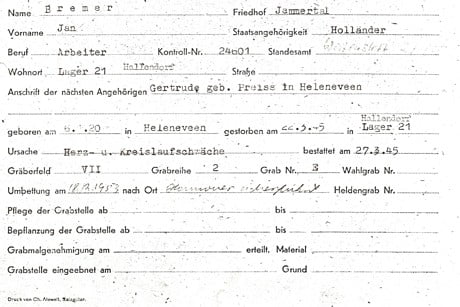
Death certificate

View all persons in the category: Died in concentration camps and as a result of forced labour