


This memorial page is dedicated to Josephus Mathias Pius Germanus Maria Peerbooms, one of more than 725 war victims connected to the municipality of Deurne documented by Stichting Oorlogsslachtoffers. The municipality of Deurne and the surrounding villages of Liessel, Vlierden, Helenaveen, Neerkant and Zeilberg were liberated in the autumn of 1944 during heavy fighting. Victims fell on all sides: Allied soldiers from countries such as the United Kingdom, the United States, Canada and New Zealand, and German soldiers.
But the archive covers more than just the combat victims on Deurne soil. Residents of Deurne who lost their lives elsewhere are also commemorated: civilians who were murdered in concentration camps, forced labourers who died in Germany, people who were executed or succumbed to the effects of persecution and oppression. In addition, residents of Deurne who entered German military service and were killed elsewhere are also included.
Stichting Oorlogsslachtoffers has been documenting the story of all these people since 1995, without distinction of nationality, side or background. The goal is to give every person a name and a face, and to keep their memory alive.

| Name | : Peerbooms | |
| First names | : Josephus Mathias Pius Germanus Maria | |
| Nickname | : José (alias Don Jozé) | |
| Date of birth | : 10 August 1916 | |
| Place of birth | : Deurne | |
| Residence | : Stationsstraat B3, Deurne | |
| Rank / Occupation | : Member of the Resistance | |
| Identity tag | : – | |
| Unit | : – | |
| Date of death | : 13 July 1944 | |
| Place of death | : Deurne | |
| Cause of death | : Executed by the resistance group ‘Zwarte Plak’ | |
| Cemetery | : – | |
| Memorial site | : – | |
Additional information
Son of Joannes Augustinus Peerbooms and Johanna Henrica Janssens.
Josephus Mathias Pius Germanus Maria Peerbooms was an adventurous member of the Resistance but was regarded by some as an informer for the German S.D. ‘Sicherheitsdienst’. This suspicion arose, amongst other things, from the arrests of Cornelis Klaas Noordermeer and Nico van Oosterhout in Utrecht; they had, in fact, travelled to Utrecht on Peerbooms’ instructions to attend a meeting of ‘De Raad van Verzet’ (the Resistance Council), or RVV. (Both were executed by firing squad in Vught on 11 August 1944).
According to a report drawn up by the mayor of Leende, Justinus Vogels, Peerbooms was arrested by the political police in Eindhoven on the grounds that he had allegedly shot two members of the Landwacht near Leenderheide. By chance, Peerbooms passed the scene of the crime shortly after the incident and was arrested by the Eindhoven political police because they found a firearm on him. Peerbooms was imprisoned in Eindhoven and subsequently transferred to Camp Vught; when it later transpired that Hans Verbeek had been the shooter, a certain Mr Sprankenis from Leende did everything in his power to secure Peerbooms’ release, which he succeeded in doing. Peerbooms, however, pretended that he had escaped from Camp Vught; but following an investigation by the Resistance, it was established that Sprankenis was the one who had secured Peerbooms’ release, leading the Resistance to suspect that Peerbooms might well have been spying for the SD and that Sprankenis must have been aware of this.
Peerbooms was also said to have had an affair with Mies Nelemans-Phaf (daughter of Jan Phaf, mayor of Gemert), the wife of resistance fighter and Bakel doctor Dr Jan Nelemans, and this had caused a rift, because after a meeting of the national underground in Weert was betrayed, the name ‘Don Jozé’ came up once again. As a member of the Resistance, Peerbooms knew dozens of safe houses used by pilots and could have betrayed countless pilot helpers and Resistance members in the Peel region to the Germans. The order to track him down, following his possible double role during the war, was issued after a meeting of members of the Resistance. This meeting was held at the home of Dr Jan Nelemans, but his wife Mies – with whom Peerbooms was rumoured to have had an affair – had overheard what was discussed at the meeting and passed the information on to Peerbooms. According to Henk Struik, who was also present at this meeting, there was talk of hard evidence against Peerbooms; however, this evidence was not brought to light at the time but was to be made public after the liberation – though this never actually happened. Henk Struik had not taken the decision to liquidate Peerbooms seriously either, as decisions had often been made in the past which were subsequently not carried out; for Struik, Peerbooms had never committed treason, as evidenced by the following.
When Peerbooms became suspicious about the warrant for his arrest, he went into hiding at Sprankenis’s in Leende, where he stayed for two weeks; during this period, Peerbooms would have had the opportunity to betray his ‘enemies’, which he did not do, but upon his return to Deurne, he was arrested by several members of the Resistance. According to various statements, an SD (Sicherheitsdienst) membership card was found in Don Jozé’s breast pocket after he had been disarmed. However, no such membership card for so-called ‘V-Männer’ – SD informants – has ever existed. Furthermore, it would have been to carry S.D. documents or the like on his person; indeed, had such evidence actually been found, this conclusive proof would have come in very handy for rendering some form of account after the war.
Josephus Mathias Pius Germanus Maria Peerbooms (alias Don Jozé) was, although no conclusive evidence of his guilt was found, killed by young men who had previously been his friends; this most likely took place near the Snoertsebaan in Liessel. After the war, attempts were made in vain to locate the grave of Josephus Mathias Pius Germanus Maria Peerbooms.
A report dated 14 November 1944, drawn up by G.M. van Loon – who, following the departure of Baron De Smeth from Deurne, presumably became the ‘Commander of the Resistance Council, Brabant district’ – states, amongst other things: “Our group also, under my command and on orders, eliminated the well-known provocateur José Peerbooms, who had no fixed abode but was then staying in a house between Helmond and Deurne.”
In a statement by Henk Brandhorst, who committed the murder of Erwin Michael Joseph, Brandhorst explicitly names Josephus Mathias Pius Germanus Maria Peerbooms as the accomplice who, according to Brandhorst, ensured that the murder weapon, a hammer, disappeared. He is also said to have been involved in digging two graves in advance and in burying Erwin Michael Joseph.
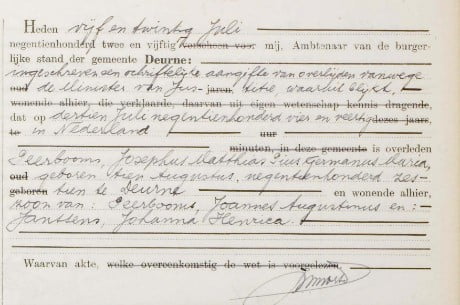
Death Register
View all persons in the category: Shot, liquidated or murdered in some other way