


This memorial page is dedicated to Maria Francisca van Otterdijk, one of more than 725 war victims connected to the municipality of Deurne documented by Stichting Oorlogsslachtoffers. The municipality of Deurne and the surrounding villages of Liessel, Vlierden, Helenaveen, Neerkant and Zeilberg were liberated in the autumn of 1944 during heavy fighting. Victims fell on all sides: Allied soldiers from countries such as the United Kingdom, the United States, Canada and New Zealand, and German soldiers.
But the archive covers more than just the combat victims on Deurne soil. Residents of Deurne who lost their lives elsewhere are also commemorated: civilians who were murdered in concentration camps, forced labourers who died in Germany, people who were executed or succumbed to the effects of persecution and oppression. In addition, residents of Deurne who entered German military service and were killed elsewhere are also included.
Stichting Oorlogsslachtoffers has been documenting the story of all these people since 1995, without distinction of nationality, side or background. The goal is to give every person a name and a face, and to keep their memory alive.

| Name | : van Otterdijk | |
| First names | : Maria Francisca | |
| Nickname | : Maria | |
| Date of birth | : 29 March 1922 | |
| Place of birth | : Vlierden | |
| Residence | : Astenscheweg V 46 aa, Vlierden | |
| Rank / Occupation | : – | |
| Identity tag | : – | |
| Unit | : – | |
| Date of death | : 25 September 1943 | |
| Place of death | : Vlierden | |
| Cause of death | : as a result of a fatal gunshot wound to her lower body | |
| Cemetery | : – | |
| Memorial site | : War memorial at St Willibrord’s Church in Vlierden | |
Additional information
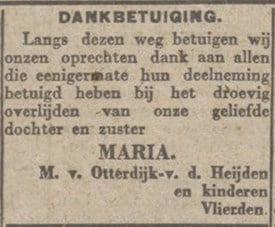
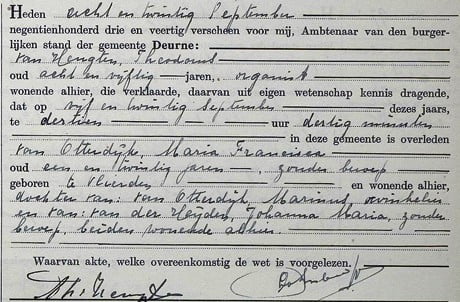
Daughter of Marinus van Otterdijk and Johanna Maria van der Heijden.
Maria Francisca van Otterdijk was fatally shot in the vicinity of ‘De Rakt’ in Vlierden during a shooting from a train travelling from Venlo towards Eindhoven. Maria had been to the market in Helmond and, whilst on her way back, a train carrying German soldiers passed by at around half past one and, for unknown reasons, opened fire on her. Maria was found fatally wounded on the cycle path near ‘De Rakt’, but initially a crime was not suspected, particularly as the doctor had issued a statement that Maria Francisca van Otterdijk had died of a heart attack. However, several witnesses had heard a shot as the train passed; in Zeilberg too, shots were fired deliberately from the passing train, though no one was injured in that incident.
Dr W. Branderhorst from Helmond carried out the post-mortem; a pointed bullet was found in Maria Francisca van Otterdijk’s body, presumably fired from a German infantry carbine. The Venlo Ortskommandantur, Feldgendarmerie, launched an investigation, following which the complete file—comprising various witness statements and X-rays—was submitted to the ‘Gericht der Feldkommandantur 674’ in Breda for the purpose of settling a claim.
Official Report
On 25 September 1943, at approximately 2.30 pm, I, Johannes Antonius van de Vorst, Sergeant of the Marechaussee, belonging to the aforementioned Group, Vlierden Post,at my home in Vlierden, I was informed that on the cycle path running from Helmond to Vlierden, within the municipality of Deurne at a place known as ‘de Rakt’, a girl named Maria van Otterdijk from Vlierden had been found and was in a dying condition. I immediately went to the scene to conduct an investigation. On my way to the location indicated to me, I encountered the girl’s father, who informed me that his daughter had already passed away and that she had been taken to the home of W. Schrama in Vlierden, near sentry post 28. At Schrama’s house, I found Maria van Otterdijk, whom I knew well, lying on a bed on the floor in the front room of the house. Upon my arrival, it became apparent that the girl had already died. Externally, there were no visible marks on the body to suggest that a struggle or anything of the sort had taken place; her face was very pale. Medical and spiritual assistance had already been provided. I learnt at the scene that Dr Nelemans from Bakel had already certified the death. He had since left, as had a priest from Vlierden. The girl’s parents had already been notified and had been to the scene. The girl’s father, named Marinus van Otterdijk, informed me that the girl in question was his daughter and was named Maria van Otterdijk. I myself knew the girl very well too, so it was clear that the girl in question belonged to the family of Mr van Otterdijk in Vlierden.
In connection with the above, I interviewed: Margaretha Alofs, aged 57, wife of Marinus Nooyen, with residence at Vlierden, Wachtpost 28, in the municipality of Deurne, who showed me the spot where the girl had been found. This was on the cycle path running from Helmond to Vlierden, within the municipality of Deurne. At the scene, I found no traces indicating a crime, and even if there might have been any, they would probably have been washed away by the rain. The aforementioned Margaretha Alofs further stated to me as follows:
“On 25 September 1943, at around 1.30 pm, I was at my home at Wachtpost 28 in Vlierden. At that time, I saw Maria van Otterdijk, whom I knew well, cycling past my house along the cycle path that runs alongside my house in the direction of Vlierden. A few metres behind her was another person whom I did not recognise. After a few minutes, I also set off on my bicycle in the same direction. After cycling about 300 metres along the cycle path towards Vlierden, I saw that on this cycle path, the person who had cycled past my house with the girl a short while earlier was standing, bent over the girl, who was lying on the cycle path. When I reached them, it turned out to be Maria van Otterdijk. I asked that person what had happened, to which he replied that the girl had fallen and thought that a tyre on her bicycle had burst, but that was not the case. I then noticed that the girl looked very pale. She was complaining of pain in her legs and stomach. The person standing by the girl when I arrived turned out to be a certain Mr Dirks from Helmond. With the help of neighbours I had alerted, I carried the girl on a bed and a ladder to the home of Mr Schrama, who lives next door to me. Upon my arrival and during the journey, the girl said nothing other than ‘my leg hurts’ and ‘my stomach hurts’. I administered some first aid, and shortly afterwards she passed away. In the meantime, Dr Nelemans from Bakel had been alerted and arrived on the scene shortly afterwards. He examined her chest and eyes and said, ‘It is too late.’ By this he meant that she was dead. We then washed the girl a little, with Dr Nelemans assisting us. Whilst washing her, we noticed that blood was flowing between her legs and beneath her bottom, which the doctor also saw; however, he indicated to us that this was due to menstruation. Once the doctor had left and we were continuing to attend to the girl, we noticed that she had a small wound on her left thigh, from which blood was continuously flowing. I thought at the time that the wound had been caused by the fall. After we had undressed the girl and washed her, she was taken home by her family. I cannot tell you any more than that.”
Subsequently, I, van de Vorst, contacted Dr Nelemans in Bakel, who informed me by telephone that the girl in question had died of cardiac arrest and subsequently provided me with a written statement to that effect. I then travelled to Helmond to interview two people who were reportedly at the scene shortly after the accident. On my return, I learnt that the Sisters of the Convent of St Josephin Deurne, who had examined the body further at her parents’ home, had discovered a small wound, which closely resembled a gunshot wound or bullet hole. As soon as I became aware of this, I immediately informed my Group Commander, and on his orders, Dr Nelemans was summoned once more to examine the body in order to carry out a further investigation. This examination then took place on 26 September 1943, at around 10 o’clock in the morning. At that time, this doctor stated that the girl had sustained a gunshot wound to her left thigh and had died as a result. Since Dr Nelemans had issued a written statement to the effect that the girl had died as a result of cardiac arrest and a criminal act was not immediately suspected, the Public Prosecutor in ‘s-Hertogenbosch was informed of my findings by telephone on 25 September 1943. When, on 26 September 1943, it became apparent that a crime was likely to have been committed, I immediately informed my Group Commander in Deurne of the matter, seized the body and sealed the room in which it was found. My Group Commander instructed me to inform the Public Prosecutor immediately of my further findings, which I did. Subsequently, the following were notified: the Mayor of Deurne and the Divisional Commander of the Military Police in Deurne, who came to the scene in person, whilst the State Police Dog Handler Sieben in Swalmen was asked to come to the scene with the State Police Dog. That very same afternoon, at around 2.00 pm, the Public Prosecutor’s Office arrived at the scene, whilst Sieben also arrived with his dog; however, the search with the dog yielded no results. We established that the girl was found on the Vlierden–Helmond cycle path, within the municipality of Deurne, approximately 400 metres from Guard Post 28. Upon investigation, it transpired that three people had passed by the spot where the girl had fallen, and they were interviewed in turn and stated:
Franciscus Josephus Dirks, born in Helmond on 8 August 1889, a cotton printer by trade and with residence at No. 11 Slegerdwarsstraat, Helmond, who stated:
“On 25 September 1943, at 1.00 pm, I was cycling from Helmond to Vlierden along the ‘de Rakt’ cycle path. About 100 metres past Checkpoint 28 on the Helmond–Vlierden cycle path, within the municipality of Deurne, a girl unknown to me cycled past me. When this girl had passed me by about 250 to 300 metres and I was cycling up a hill at that spot, I saw that the same girl who had cycled past me a moment earlier was lying on the cycle path beneath her bicycle. When I saw her lying there, I cycled a little faster and, when I reached her, I took her bicycle from her, leaned it against a tree and asked if she had cycled into a tree, to which she gave no reply. She looked very pale and complained of pain in her right leg and in her stomach. I helped her up and wanted to sit her against a tree on the roadside, but she was complaining so much of pain in her stomach that I left her lying down and supported her under her arms. After I had stayed with the girl for a few moments, Mrs Nooijen from Guard Post 28 came over to me and helped me. This woman alerted the neighbours, and with their help the girl was taken to Schrama’s house, which is situated near Guard Post 28. Once help had arrived, I left as I still had some shopping to do. However, I first notified the girl’s parents in Vlierden. I was driving relatively close behind the girl. However, I did not see her fall and do not know how the accident occurred. I did notice that a shot was fired around the time the girl fell, though I cannot say in which direction – only that it was in the vicinity where the girl fell. However, when I picked the girl up, I did not realise she had been injured by a gunshot. I did, however, think that a hunter was shooting, although I did find this rather strange at the time. I cannot tell you any more than that.”
Franciscus Johannes Cornelis van Lieshout, aged 47, cotton printer, residing at No. 12 Verhooijschestraat, Helmond, who stated:
“On 25 September 1943, at 1.30 pm, I was at a place called ‘Villa’ near the ‘Rakt’ amongst the elderberry bushes, in the municipality of Deurne. There I heard a shot ring out and at the same time saw a magpie fly out of a maize field. I thought someone was hunting in that maize field, but this turned out not to be the case.At the very moment the shot was fired, a train travelling from Deurne towards Helmond also passed by. However, I paid no further attention to either the train or the shot and continued on my way towards the Vlierden–Helmond cycle path. On this cycle path, I saw the wife of Guard Post 28 and a few other people who were attending to a girl. As I drew nearer, I saw that they were placing her on a ladder and carrying her away. I learnt from bystanders that the girl had been involved in an accident. I helped transport her to Schrama’s house near Guard Post 28 on the Rakt. I did not see any suspicious persons in the area where I found the girl. The shot I heard did come from the direction of the railway line, but I cannot say whether it was fired from the train, although this is certainly possible.”
Adrianus Antonius Vos, aged 43, Foreman at N.V. Philips, with residence at No. 26 Zuidwal, Helmond. He stated:
“On 25 September 1943, at approximately 1.30 pm, I was cycling from Vlierden towards ‘de Rakt’. When I was just outside the village of Vlierden and on the cycle path leading towards ‘de Rakt’, I heard a shot ring out. However, I cannot say from which direction this shot came. After cycling for about 5 to 6 minutes along the aforementioned cycle path, I came upon a girl sitting against a tree, who was being supported by a woman unknown to me, who later turned out to be Mrs Nooijen. Mrs Nooijen told me that this girl had been found there on the cycle path and had presumably been involved in an accident. After I had stood with the girl for a few more moments, local residents arrived carrying a ladder, onto which the girl was placed and carried to Schrama’s house near Guard Post 28. As far as I could tell, the girl was still alive when I arrived, though she was no longer speaking. At Schrama’s house, I did notice that the girl was shivering slightly. When we brought the girl into Schrama’s house, it was five past two. The accident that befell the girl must therefore have occurred between 1.30 pm and 2.00 pm. I cannot tell you any more than that.”
After questioning these individuals, we examined the girl’s clothing, whereupon it became apparent that there was a small hole in the coat and petticoat, at the level of the left thigh. The hole was the size of a pea and appeared to be a bullet hole. We seized these items of clothing. On the orders of the Public Prosecutor, the body was transferred on 26 September 1943 to the convent in Deurne and was examined there, at the request of the aforementioned Public Prosecutor and the Investigating Magistrate, by Dr W. Branderhorst from Helmond, at the request of the aforementioned Public Prosecutor and Investigating Magistrate, whereupon it was found that a carbine bullet was lodged in the lower abdomen of this girl’s body; this bullet was removed from the body by Dr Branderhorst and handed over to us. This bullet, 37 mm in length and 8 mm calibre, was a pointed bullet. We have seized it. (The Feldgendarmerie in Venlo stated that the bullet found is presumed to have come from a German infantry carbine). Following these findings, the body was released in consultation with the Public Prosecutor, on condition that the Feldgendarmerie in Venlo be notified in advance, which we did; they commenced an investigation on 27 September 1943 and took over the further investigation. At the request of the Feldgendarmerie, the bullet found was handed over to them. The Feldgendarmerie also released the body, so that we were able to make it available to the parents.
A report by Dr Branderhorst will be sent by him to the Public Prosecutor. As the German authorities have taken the bullet from us, it is not included among the documents. The girl’s clothes will remain in safekeeping at the Group Office in Deurne until further notice. According to the identity card and the birth certificate enclosed herewith, the girl’s name is: Maria Francisca van Otterdijk, born in Vlierden, municipality of Deurne, on 29 March 1922, with residence at Astenscheweg V 46.aa, Vlierden, municipality of Deurne.
As it cannot be ruled out that the shot was fired from a train, and partly in view of the witnesses’ statements that they heard shots at a time when a train was passing, we have also taken a statement from: Bouwe Grijpstra, aged 59, stationmaster for the Dutch Railways, with residence in Deurne, who stated:
“The register shows that on 25 September 1943, at 13.20, train D.G. No. 77042, coming from the direction of Venlo and travelling towards Helmond, passed through Deurne. At 13.47, a passenger train No. 1251 arrived in Deurne from the direction of Helmond and departed again at 13.55, heading back towards Helmond, from Deurne Station. Upon investigation, I, Koenders, have ascertained that train D.G. No. 77042 arrived in Helmond at 13.31.”
Meanwhile, we learnt that in the hamlet of Zeijlberg near Deurne, on 25 September 1943 between approximately 1.00 pm and 2.00 pm, shots had also been heard by residents of this hamlet, prompting us to launch an investigation, during which Sergeant Major Arnoldus van den Heurik took statements on 27 September 1943:
“On 25 September 1943 between 1.00 pm and 2.00 pm – I no longer remember the exact time – I was in the kitchen of my house in Zeijlberg with the door open, when suddenly I heard two shots ring out, which sounded quite loud. I then went outside to see if my horse was being shot at; it was grazing in the meadow near my house, alongside the railway line. However, the horse was simply grazing. In my opinion, the shots I heard came from the direction of the railway line, over which a train carrying German soldiers was passing at that very moment; this train had come from the direction of Venlo and was heading towards Helmond. Later, I heard from my son-in-law, Mr Kuunders, who was working in the fields on horseback, that he had also heard gunshots. My home is situated 250 metres from the Venlo–Eindhoven railway line.”
Josephus Wilhelmus Kuunders, aged 34, farmer, with residence at Zeijlberg Z 193, Deurne, who stated:
“On the afternoon of 25 September 1943, between 1 pm and 2 pm, I was working in the fields near my home. I then saw and heard a train travelling towards Helmond on the railway line, which was 300 metres away from me. At the same time, I heard a shot ring out and I also noticed that the bullet from that shot whizzed past me. I heard only one shot, and it came from the direction of the moving train, which was passing along the railway line at that moment.”
An official report on the seizure and handover of the body is attached to this official report.
This official report, drawn up by us under oath in respect of all findings, was signed and sealed at Deurne on 27 September 1943.
Chief Constable Th. Koenders
Senior Constable A. v. d. Heurik
Constable A. v. d. Vorst
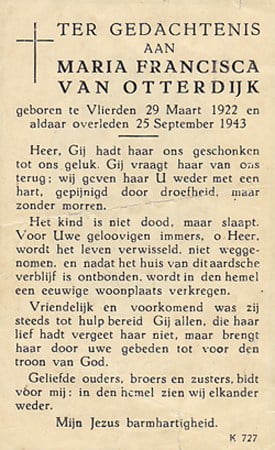
Memorial card
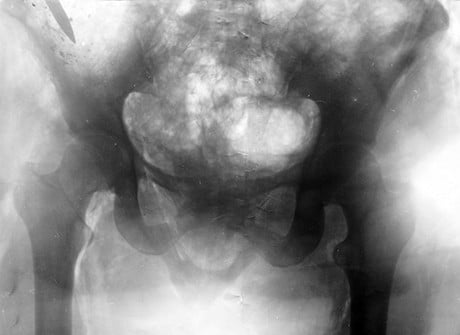
X-ray showing the pointed bullet clearly visible in the top left-hand corner
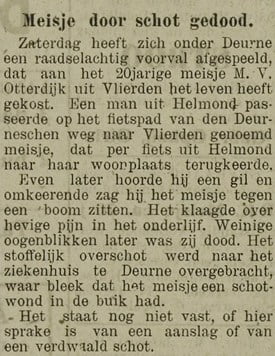
‘Peel en Maas’ of 02-10-1943
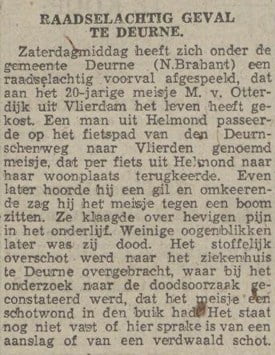
‘Delftsche Courant’ of 27-09-1943
‘Provinciale Zeeuwse Courant’ of 28-09-1943
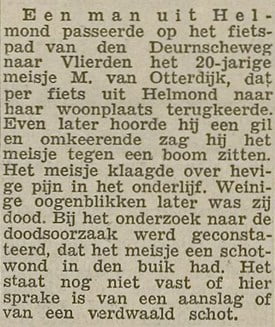
Zierikzeesche Nieuwsbode, 29 September 1943
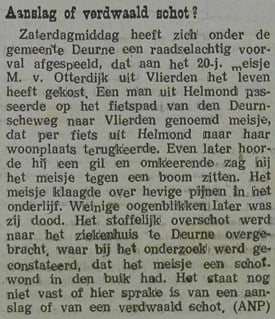
De Zuid-Willemsvaart, 2 October 1943
Death register
A comprehensive file may be available for inspection from the author.
View all persons in the category: Shot, liquidated or murdered in some other way