


This memorial page is dedicated to Marinus Bankers, one of more than 725 war victims connected to the municipality of Deurne documented by Stichting Oorlogsslachtoffers. The municipality of Deurne and the surrounding villages of Liessel, Vlierden, Helenaveen, Neerkant and Zeilberg were liberated in the autumn of 1944 during heavy fighting. Victims fell on all sides: Allied soldiers from countries such as the United Kingdom, the United States, Canada and New Zealand, and German soldiers.
But the archive covers more than just the combat victims on Deurne soil. Residents of Deurne who lost their lives elsewhere are also commemorated: civilians who were murdered in concentration camps, forced labourers who died in Germany, people who were executed or succumbed to the effects of persecution and oppression. In addition, residents of Deurne who entered German military service and were killed elsewhere are also included.
Stichting Oorlogsslachtoffers has been documenting the story of all these people since 1995, without distinction of nationality, side or background. The goal is to give every person a name and a face, and to keep their memory alive.

| Name | : Bankers | |
| First names | : Marinus | |
| Nickname | : – | |
| Date of birth | : 30 April 1920 | |
| Place of birth | : Asten | |
| Residence | : Leensel 7, Asten | |
| Rank / Occupation | : – | |
| Identity tag | : – | |
| Unit | : – | |
| Date of death | : 9 October 1944 | |
| Place of death | : Heeze | |
| Cause of death | : as a result of an explosion | |
| Cemetery | : – | |
| Memorial site | : War memorial in Liessel | |
| : War memorial at St Willibrord’s Church in Liessel | ||
| : War memorial in Asten | ||
Additional information
Son of Hendrikus Bankers and Petronella van Laanen, brother of Henricus Bankers.
In the early afternoon of 9 October 1944, a patrol of two German soldiers was spotted in the Zandse Woods and captured by Allied troops. This incident was witnessed by a group of around 20 men and boys.
A strange-looking explosive device, presumably intended to blow up the Sluis XI bridge, caught the group’s attention. Although the German prisoners, who were being escorted by Allied troops, had warned of the dangerous object, an unfortunate mishandling triggered the explosive, causing it to detonate with a deafening bang. The consequences were horrific: eight bystanders were killed instantly; of those critically injured, a further five people died within a week and one child a few weeks later; making a total of 13 fatalities. All this took place at the Rinkveld in Asten, near Liessel.
Piet Gitzels, formerly commander of the Liessel K.P., was now leader of the O.D. It is certain that the O.D. was involved in the pursuit of several German soldiers who had been spotted in the vicinity of the Leensel and Rinkveld. The O.D. must have been warned by people at the scene. “I jumped onto the back of an American Sherman tank as we were chasing them and we even fired at them,” Piet Gitzels stated in an interview. He still remembered that tremendous explosion behind him!
The true circumstances of a bizarre incident?
The first report of this terrible event appeared in the weekly magazine *Peelbelang*, published by Schriks Drukkerij in Asten in 1944, and was described by the writer Piet van der Zanden in a serialised story entitled *The Battle of the Peel*. It can be found on page 62 of his later book *The Battle of the Peel*. In connection with that disaster, he made no mention of people who might have been tasked with clearing up munitions left behind by the Germans.
Some 50 years later, Harrie Rijnders wrote the following about this on page 39 of his book “Liessel Brandt”:
Two officials from the municipality of Asten, tasked with clearing munitions left behind by the Germans, joined the group.
This strongly suggests censorship, designed to avoid having to name one or more suspects. There are three reasons why the pair in question (Harrie Michiels and Piet Manders) had nothing to do with the removal of munitions, as stated.
The officials, and why they were there: –
The timeframe would have been virtually impossible for notifying Asten, alerting their staff and dispatching them whilst people were gathering at the scene whilst the chase was still underway.
– Their lack of security and authority. Their first instruction to the public should have been to get out of there as quickly as possible for their own safety.
– Their inability to render the weapon harmless.
Note: Although both individuals, Harrie Michels and Piet Manders, were municipal workers in Asten, no statement has ever been published confirming whether these two men were in fact appointed to dismantle and/or remove munitions, nor where they would have received such training.
The ‘ammunition box’
Various people who wrote about this subject spoke of a ‘box’ as if it consisted of a few planks nailed together. In reality, it was a ‘Riegelmine 43’, or in plain English, a rod mine: an elongated device made of sheet iron, divided into several compartments and containing a charge of 4 kilos of TNT, though without any shrapnel filling. It was a tank mine that generated air pressure with enormous force, sufficient to flip a heavy tank upside down. It required a considerable amount of weight to activate the detonator(s).
When used as a booby trap mine, however, the situation was quite different, and this mine may well have been intended to disable the Sluis 11 Bailey bridge near Asten. For use as a booby trap, this mine was fitted with several wires connected to anti-tamper ‘fuses’. Inexpert tampering with these wires could lead to an explosion, which is precisely what happened in this case.
Who were the officials? One of them had Piet Manders as their resident, who lived on the Rinkveld; the other was Harrie Michels from the village of Asten, who regularly cycled from Asten via Voordeldonk and Rinkveld, turning off at Ciske de Ketel’s (Jan Roijakkers) onto the sandy path leading to the Dennendijk. At that time, it still ran from Brand to Café Bakkers. He followed this path to the eastern edge of the Staatsbos (now the Dennendijkse woods), where, along the ‘singel’ (the boundary of the woods marked by three rows of birch trees), he had set snares stretching for almost two kilometres right to the south-easternmost tip. He then passed right under Knelis Timmermans’s nose, near his farm, wearing his distinctive blue-painted clogs, which gave him away.
Who better than the latter knew how to handle wires, given his experience with snares and wire? Harrie Michels, for whom no memorial page has been set up on this site as he was not born, lived or died in Deurne, also lost his life in the explosion.
See also: Huub Timmermans (2008), Aeroplanes over ‘De Hutten’ 1940–1945, Lulu.
Memorial card:
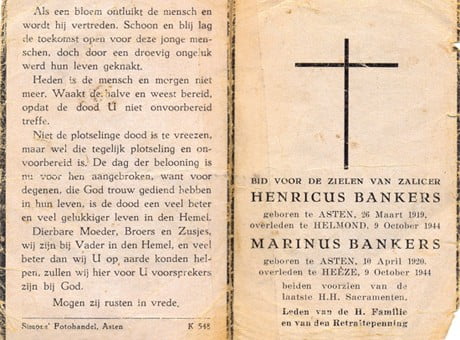
Joint memorial card:

View all persons in the category: Not in any category, but listed on a monument in Deurne