


This memorial page is dedicated to Martinus Antonius van den Eijnden, one of more than 725 war victims connected to the municipality of Deurne documented by Stichting Oorlogsslachtoffers. The municipality of Deurne and the surrounding villages of Liessel, Vlierden, Helenaveen, Neerkant and Zeilberg were liberated in the autumn of 1944 during heavy fighting. Victims fell on all sides: Allied soldiers from countries such as the United Kingdom, the United States, Canada and New Zealand, and German soldiers.
But the archive covers more than just the combat victims on Deurne soil. Residents of Deurne who lost their lives elsewhere are also commemorated: civilians who were murdered in concentration camps, forced labourers who died in Germany, people who were executed or succumbed to the effects of persecution and oppression. In addition, residents of Deurne who entered German military service and were killed elsewhere are also included.
Stichting Oorlogsslachtoffers has been documenting the story of all these people since 1995, without distinction of nationality, side or background. The goal is to give every person a name and a face, and to keep their memory alive.

| Name | : van den Eijnden | |
| First names | : Martinus Antonius | |
| Nickname | : Martien (alias Watje) | |
| Date of birth | : 4 February 1917 | |
| Place of birth | : Venray | |
| Residence | : Griendtsveenseweg Z.148 (Crisishoeve) in Deurne | |
| Rank / Occupation | : Member of the Resistance / Butcher | |
| Identity tag | : – | |
| Unit | : – | |
| Date of death | : 5 September 1944 | |
| Place of death | : America | |
| Cause of death | : presumed to have been beaten to death | |
| Cemetery | : Roman Catholic Cemetery in Zeilberg | |
| Memorial site | : War memorial in Zeilberg | |
| : War memorial in Griendtsveen | ||
| : Provincial Memorial ‘The Brabant Soldier’ in Waalre | ||
Additional information
Son of Johannes van den Eijnden and Hendrina Claessens.
There are a number of stories circulating about the circumstances surrounding the death of Martinus Antonius van den Eijnden; it therefore remains a matter of speculation as to which of the stories is correct, but see the account by Henk Struik below.
“In early September ’44, on the evening before van den Eijnden and de Bruijn were killed, another meeting took place at the Crisishoeve. Present there, alongside van den Eijnden and de Bruijn, were Henk and a few others. As they were leaving, it was agreed that Henk would return the following morning. Nothing was agreed regarding any possible mission the next day. During the night, a German train derailed near the Clarinet; the German soldiers then moved into the Zeilberg and went from house to house, knocking on doors to take men and boys away to help with the derailed train.
When Henk wanted to go to the Crisishoeve, Mrs Piijnenburg stopped him and hid him in her house. She was afraid that otherwise he would be caught by the Germans, forced to help with the train and then taken to Germany. Consequently, Henk did not go to the Crisishoeve that morning.
Meanwhile, from the Crisishoeve, they had seen Germans take a child’s bicycle. Tinuske and Frits were so angry about this that they immediately got into the car and set off in pursuit of the Germans. They took the bicycle back from the Germans; Henk does not know what happened after that.
Following a search, Tinuske and Frits were found the next day. Dr van Noord was called to the scene, but he could only confirm their deaths. On Saturday evening, the funerals took place: Martien’s in Zeilberg and Frits’s in Asten.”
It is not known exactly how the execution took place, but given their injuries, they were presumably beaten to death by the Germans.
After the war, he was posthumously awarded the Medal of Freedom.
Railway guard Piet Seijkens from Zeilberg is also said to have been arrested and beaten by the Germans whilst he was patrolling the railway line at the time; however, he managed to flee into the Peel. Two Americans, W. Verstegen and G. Elbers, who happened to be cycling from Griendtsveen at the same time, were also detained by the Germans. Both were forced onto the train in question to be interrogated, but were thrown from the moving train a short distance further on.
Memorial card

Joint memorial card
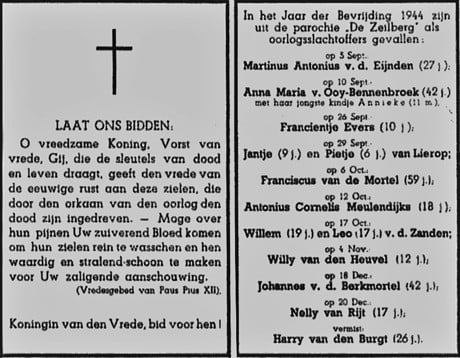
Commemorative card
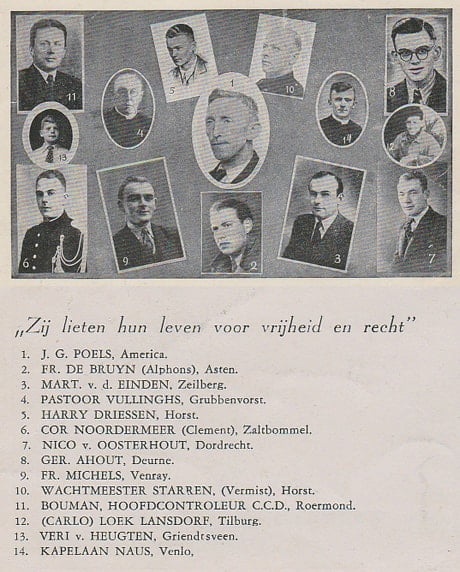
View all persons in the category: Shot, liquidated or murdered in some other way