


This memorial page is dedicated to Albert George Birch, one of more than 725 war victims connected to the municipality of Deurne documented by Stichting Oorlogsslachtoffers. The municipality of Deurne and the surrounding villages of Liessel, Vlierden, Helenaveen, Neerkant and Zeilberg were liberated in the autumn of 1944 during heavy fighting. Victims fell on all sides: Allied soldiers from countries such as the United Kingdom, the United States, Canada and New Zealand, and German soldiers.
But the archive covers more than just the combat victims on Deurne soil. Residents of Deurne who lost their lives elsewhere are also commemorated: civilians who were murdered in concentration camps, forced labourers who died in Germany, people who were executed or succumbed to the effects of persecution and oppression. In addition, residents of Deurne who entered German military service and were killed elsewhere are also included.
Stichting Oorlogsslachtoffers has been documenting the story of all these people since 1995, without distinction of nationality, side or background. The goal is to give every person a name and a face, and to keep their memory alive.

| Name | : Birch | |
| First names | : Albert George | |
| Nickname | : Albert | |
| Date of birth | : – | |
| Place of birth | : Lincolnshire | |
| Residence | : in Peterborough, Northamptonshire | |
| Rank / Occupation | : Sergeant | |
| Identity tag | : 7912202 | |
| Unit | : R.A.C. “C” Squadron, 2nd County of London Yeomanry | |
| Date of death | : 3 November 1944 | |
| Place of death | : Neerkant | |
| Cause of death | : – | |
| Cemetery | : Mierlo War Cemetery | |
| Memorial site | : St Peter’s Church War Memorial in Barrowden | |
Additional information
Grave location: V. D. 6.
Aged 30. Son of Albert George and Lettie Anne Birch; widow Edith Birch, of Peterborough, Northamptonshire.
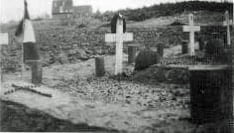
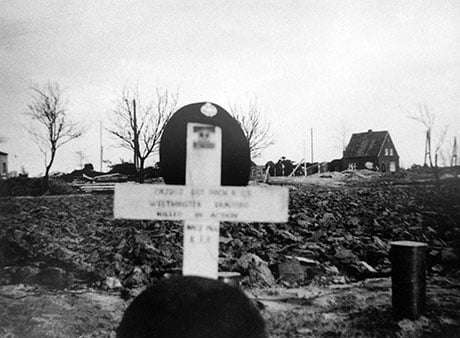
Albert George Birch’s field grave was situated near Piet Franssen on Heitrak No. 31 in Neerkant.
Early in the morning, 3rd Troop began clearing the road of mines in the vicinity of (coordinate 698083), somewhere between the Paalberg and the Scheper Jannebaan, using mine clearance equipment. Sergeant Albert George Birch led the way, followed by Corporal Shaw, with Lieutenant Brian Hatherley Pear bringing up the rear. They passed a Churchill tank and an armoured car, which had driven over landmines the previous day, forcing them to take a detour to the right across a meadow. As Corporal Shaw’s tank had collided with a tree, rendering the mine-clearing equipment inoperable, Lieutenant Brian Hatherley Pear took his place.
Suddenly, just as the mine-clearing was almost complete, Sergeant Albert Georg Birch’s tank came under fire from a German anti-tank gun; although the crew remained unharmed and the tank did not catch fire, Lieutenant Brian Hatherley Pear ordered Sergeant Albert Georg Birch to abandon the tank. Every attempt to leave the tank was met with machine-gun fire from the Germans, preventing them from exiting. Several Churchill tanks from the Grenadier Guards then laid down a smoke screen around Sergeant Albert Georg Birch’s tank, and Lieutenant Brian Hatherley Pear drove towards him so that his tank could act as a shield against the German machine-gun fire, allowing the crew to leave the tank safely. The smoke screen made it difficult to see exactly what was happening, but both tanks were suddenly ablaze; furthermore, Corporal Shaw’s tank had driven over a mine and was also immobilised. Corporal Shaw also ordered his crew to abandon the tank and, despite the fact that there were also some casualties amongst the Grenadier Guards, they once again provided covering fire and laid another smoke screen, enabling Corporal Shaw and his crew to leave the tank safely. Of Lieutenant Brian Hatherley Pear’s and Sergeant Albert Georg Birch’s crew, there was only one survivor; this was also noted in the Westminster Dragoon’s war diary, namely the wounded Trooper Whitford, who was taken prisoner by the Germans.
However, in the Kriegstagebuch (German war diary) of the 115th Panzer-Grenadier Regiment dated Friday 3 November 1944 at 09:15 (see below), the Germans report two British prisoners of war, including an officer; it is assumed that this refers to Lieutenant Brian Hatherley Pear. During the liberation of Maasbree, 22 November 1944, the British found the body of Lieutenant Brian Hatherley Pear; it later transpired that the Germans had done everything in their power to save his life, presumably in what was then a boys’ school, which the Germans had converted into a military hospital. Brian Hatherley Pear was buried in the Roman Catholic cemetery at Maasbree.
Excerpt from “The Westminster Dragoons in NW Europe”
Early in the morning, 3rd Troop began advancing, led by Sgt Birch, with Cpl Shaw next and Lt Pear bringing up the rear. They passed a Churchill tank and an armoured car that had been blown up by mines the previous day. To avoid these, they had to turn into a field to the right of the road; Cpl. Shaw’s tank struck a tree, which temporarily put his flail out of action, and Lt. Pear therefore took his place.
Suddenly, just as the clearing operation was almost complete, Sgt. Birch’s tank was hit by fire from an anti-tank gun; the crew were unharmed and the tank did not catch fire, but Lt. Pear ordered Sgt. Birch to bail out. Sgt. Birch replied that every time he tried to do so, a machine-gun opened fire on him. Hearing this, the Churchill tanks of the Grenadiers laid down smoke around Sgt Birch’s tank. Lt Pear then announced his intention to move forward and use his tank as a shield in front of Sgt Birch’s tank, enabling the crew to bail out.
The smoke made it very difficult to see exactly what was happening. Through gaps in the smoke, both tanks were suddenly seen to be on fire. In the meantime, Cpl. Shaw’s tank hit a mine and was unable to move. He ordered his crew to bail out, and a few minutes later their tank, too, was set alight by the anti-tank gun. The Grenadier Guards provided fire support and laid down smoke for another hour, despite the fact that they themselves were suffering casualties. This enabled Cpl. Shaw and his crew to crawl back to safety. Of Lt. Pear’s and Sjt. Birch’s crews, there was only one survivor: Tpr. Whitford. He was wounded and taken prisoner. The loss of this excellent officer, his sergeant and their very gallant men was a sad blow.
The volume of fire produced by the Germans that morning was so great that all operations by the 15th Scottish Division were postponed for 48 hours. It was decided to launch a full-scale attack on 5 November, and for this, No. 1 Troop, commanded by Lt. Hoban, took the place of No. 3 Troop in support of the Grenadiers.
War diary (German ‘Kriegstagebuch’) of the 115th Panzer-Grenadier Regiment, 3 November 1944 – 09:15, reporting two British prisoners of war, including an officer.

Field grave of Albert George Birch (wearing a beret)
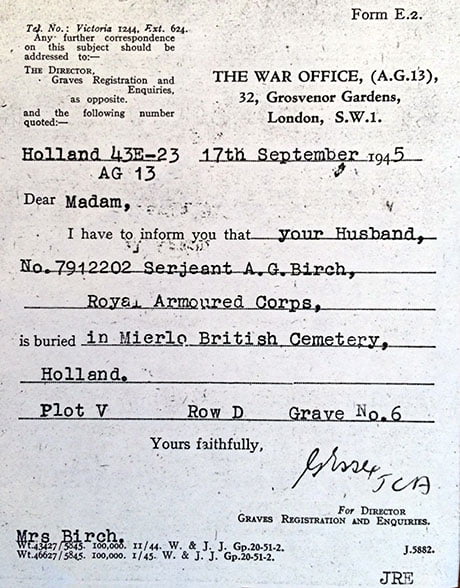
Letter from The War Office to the widow, Edith Birch, regarding the grave registration.
View all persons in the category: Allied soldiers killed in action