


This memorial page is dedicated to Arthur Owen Bosley, one of more than 725 war victims connected to the municipality of Deurne documented by Stichting Oorlogsslachtoffers. The municipality of Deurne and the surrounding villages of Liessel, Vlierden, Helenaveen, Neerkant and Zeilberg were liberated in the autumn of 1944 during heavy fighting. Victims fell on all sides: Allied soldiers from countries such as the United Kingdom, the United States, Canada and New Zealand, and German soldiers.
But the archive covers more than just the combat victims on Deurne soil. Residents of Deurne who lost their lives elsewhere are also commemorated: civilians who were murdered in concentration camps, forced labourers who died in Germany, people who were executed or succumbed to the effects of persecution and oppression. In addition, residents of Deurne who entered German military service and were killed elsewhere are also included.
Stichting Oorlogsslachtoffers has been documenting the story of all these people since 1995, without distinction of nationality, side or background. The goal is to give every person a name and a face, and to keep their memory alive.

| Name | : Bosley | |
| First names | : Arthur Owen | |
| Nickname | : – | |
| Date of birth | : 15 October 1920 | |
| Place of birth | : – | |
| Residence | : in Mesa County, Colorado | |
| Rank / Occupation | : Private | |
| Identity tag | : 37355603 | |
| Unit | : 814th Tank Destruction Battalion, 7th Armoured Division, Medical Detachment | |
| Date of death | : 29 October 1944 | |
| Place of death | : Liessel, near Kanaalstraat/Hogebrug | |
| Cause of death | : – | |
| Cemetery | : Palisade Cemetery, Colorado (USA) | |
| Memorial site | : – | |
Additional information
Arthur volunteered for military service in 1942 before completing his studies at Mesa College. He received his military training at Camp Hood and Camp Bowie in Texas and Camp Polk in Louisiana. He served for a year overseas in France, Belgium and the Netherlands. He was wounded by shrapnel in France and was awarded the Purple Heart for this; and was awarded the Silver Star for his exceptional acts of heroism and courage at the risk of his own life between 27 and 29 October 1944 during the fighting in the vicinity of ‘de Heitrak’ near Liessel.
Overview map with the exact location circled in blue, courtesy of Wesley Johnston (U.S. 7th Armoured Division Association
).
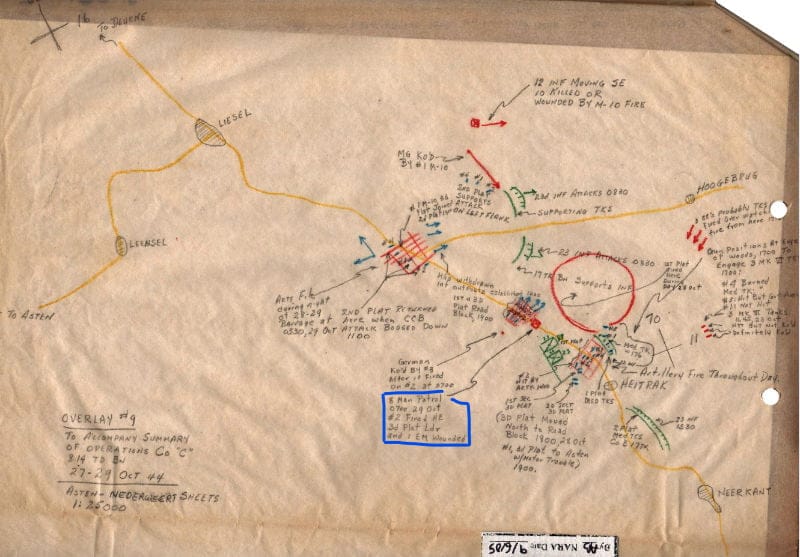
814 TD After Action Report, Oct 44 (pp. 6–7): C/814 attached to TF Wemple CCB, events on 29 October 1945:
“At around 0700, a German patrol approached the third platoon’s position from the south (see overlay). The third platoon leader and the driver of #2 destroyer advanced towards them on foot in an attempt to make them surrender and were wounded. The platoon leader ordered his #2 gun to open fire, and it moved forward and fired high-explosive rounds into the bushes where the Germans were hiding. Limbs flew into the air. A German bazooka operator fired at #2 gun from the back of a house. (See overlay #9) and #3 gun swung round and fired a round of high-explosive at him. The crew of #2 gun moved far enough forward so that the gun commander could lift the wounded driver onto the rear deck. The platoon leader, lying on his back, was too seriously wounded to be moved in that way, so he ordered the gun to continue firing and to send the medics for him. Gun #2 attempted to reverse, struck a tree with the barrel, and the gun swung round, knocking the driver and the loader – who was holding him – off the rear deck. The gun commander picked them up again and took them to the medics. The platoon leader was evacuated by Company C medics under heavy small-arms fire."
This previous entry and overlay #9 establish the position:
"The third platoon was now given a roadblock mission and moved into position by nightfall (see overlay #9). The mission was to block two secondary roads against an attack from the east. #1 destroyer, from the third platoon, had gone to Asten with engine trouble. Outposts were established and security positions dug in.”
The position was just north of Heitrak.
Gare la Bête (814 TD History by Calvin Boykin, pp. 59–60): supporting C/814 near Heitrak, Holland –
“Robert C. Fry of Great Bend, Kansas, drove an M10 tank destroyer in the 814th’s Company C. … Company C then moved to Liesel and stayed for a few days, before moving out to defend a stretch of road, spreading out with considerable distance between the tank destroyers. Fry’s account continues: ‘At dawn the next morning, 29 October, I was on guard in the tank destroyer when I saw Germans approaching from behind us. I woke the crew to get them ready. The platoon officer [WJ: 1st Lt. Burrell Woodell, 3/C/814]was just making his way down the ditch on the other side of the road, waking up the Security Section, when he was hit by machine-gun fire. I jumped out of the driver’s seat to help him, but as soon as I hit the ground I could see he was already dead. I saw two Germans crawling across the road to our right. I shot both of them, then I was hit by machine-gun fire in my left leg and thigh. My gunner, Sergeant Jules Norris, jumped out and hoisted me onto the back of the destroyer to get me to the medics. Norris was driving and crashed the gun into a tree, causing the turret to spin round and knock me to the ground. This happened in front of a small house that Captain Donald Reid was using as headquarters. The medic’s jeep came to pick me up; Medic Raymond Dye and his driver, Arthur Bosley, had already made several trips back to the British field hospital that morning, travelling via Liesel. The German officer was out in front, waving at his tank crew not to fire on us, but they did so anyway. The shot hit the jeep, spun it round and set it alight. As it spun, it threw us all out. A piece of the jeep had struck me in the right hip, causing a deep cut. Dye was thrown headfirst into a brick wall by the schoolhouse. Bosley was in the middle of the road. They shot him in the head. My assistant driver, who had been wounded, lay still and they left him alone. They looked at me, and I suppose they reckoned I was on my last legs. They knelt down, wrote down my name and service number from my dog tags, and walked away. The assistant driver and I crawled into a small stone building to hide. I can’t remember the assistant driver’s name, as he’d only been with us for two days. After a while, shells began to fall on the town and we heard the Germans moving out. Then we heard some English being spoken, and we shouted at them; they took us to the field hospital. …"
The Daily Sentinel – Grand Junction, Colorado, 6 February 1949

View all persons in the category: Allied soldiers killed in action