


This memorial page is dedicated to Meindert Postma, one of more than 725 war victims connected to the municipality of Deurne documented by Stichting Oorlogsslachtoffers. The municipality of Deurne and the surrounding villages of Liessel, Vlierden, Helenaveen, Neerkant and Zeilberg were liberated in the autumn of 1944 during heavy fighting. Victims fell on all sides: Allied soldiers from countries such as the United Kingdom, the United States, Canada and New Zealand, and German soldiers.
But the archive covers more than just the combat victims on Deurne soil. Residents of Deurne who lost their lives elsewhere are also commemorated: civilians who were murdered in concentration camps, forced labourers who died in Germany, people who were executed or succumbed to the effects of persecution and oppression. In addition, residents of Deurne who entered German military service and were killed elsewhere are also included.
Stichting Oorlogsslachtoffers has been documenting the story of all these people since 1995, without distinction of nationality, side or background. The goal is to give every person a name and a face, and to keep their memory alive.

| Name | : Postma | |
| First names | : Meindert | |
| Nickname | : Meindert, alias ‘de Witte’ | |
| Date of birth | : 21 October 1927 | |
| Place of birth | : Drachten | |
| Residence | : Noorderbuurt 24, Drachten | |
| Rank / Occupation | : Corporal / Bicycle repairer | |
| Identity tag | : 12315 | |
| Unit | : 1st Dutch Bomb Disposal | |
| Date of death | : 29 May 1945 | |
| Place of death | : Helenaveen | |
| Cause of death | : as a result of a landmine explosion | |
| Cemetery | : Zuiderbegraafplaats in Drachten, grave already cleared | |
| Memorial site | : Memorial to Mine and Ordnance Clearers | |
| See also | : How big can something small be | |
.
Additional information:
Meindert Postma was the son of Oetze Postma and Trijntje Postma-Wassenaar. Meindert had two older brothers, Job and Oebele, and a younger sister called Tinie. Two sisters with the same name, Lijsbert Elisabeth, and a younger brother called Oetze had died at a young age, which had caused the family great sorrow. The Postma family ran a furniture shop in Drachten (Friesland). Tinie, Meindert’s sister, recalls that work at the shop was hard and that their father was strict with the children. Meindert sometimes had problems with his father, which may have been the motivation for his adventure in the southern Netherlands, which had already been liberated. As there was no fuel available in the autumn of 1944, Meindert and his neighbour Lute Numan decided to go and fetch wood from the nearby village of Olterterp. However, they did not return that evening. Their parents were unable to launch a search due to the risk of being arrested for breaching the curfew. It is quite possible that Meindert and Lute were aware of the reports on Radio Oranje about the Allies advancing following the Normandy landings. Tinie recalls that Meindert was interested in technology and electricity; there were wires in their attic and it seemed as though he was building an illegal radio to listen to banned radio stations.
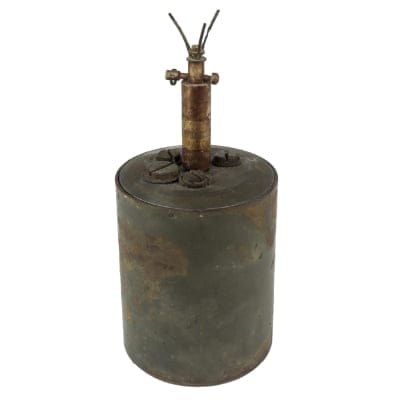
Because Meindert had lied about his age, he was only 17 when, after disappearing with Lute, he enlisted in the Canadian Army in Breda, joining the 1st Dutch Bomb Disposal Company (later the No. 1 Netherlands Mine Lifting Company). No one knows exactly how Meindert and Lute ended up in Brabant, given that the bridges over the major rivers were heavily guarded and it was difficult to get through the lines without the right contacts. Meindert underwent training at the British mine-clearing school in Knokke (B) to clear mines; he was promoted to corporal and was involved in clearing landmines and other explosives in the liberated southern Netherlands. Together with Sergeant Jean Dirven and Corporal Herman Schutte, Meindert was sent to De Peel in Deurne. Here lay extremely treacherous S-mines, which had been laid on 21 November 1944 by the German ‘Kampfgruppe Hübner’. These S-mines, also known in German as ‘Schrapnell-, Splitter- or Springmine’ and primarily known to the Allies as ‘Bouncing Betty’, are notorious anti-personnel mines. When triggered, these mines leap upwards and explode at hip height. This explosion scatters countless sharp pieces of steel in all directions. The soldiers were billeted at Van Goch butchers’ at 140 Schoolstraat in Deurne; the butcher’s still exists today and is now located at 72 Martinetplein. According to correspondence between the Postma and Van Goch families, Meindert felt very much at home with this family; he was nicknamed ‘de Witte’ because of his very fair hair, as will become clear later in this story.
Two weeks after the liberation, Meindert suddenly turned up at the door of his family’s shop in Drachten. His father had said that the door should always be left open so that Meindert could come in at any time. A large crowd gathered outside the shop when the young Meindert returned wearing the uniform of the Princess Irene Brigade, and his family was very proud of him. According to Tinie, it felt as though he had risen from the dead, as they had heard nothing from him all that time. Once home, he cleaned the graves of his little brother and sister; Tinie described him as a sensitive boy. Meindert stayed in Drachten for three days; after that, Tinie waved him off at the main bridge in the town centre, where Meindert got into a Canadian army vehicle and headed back to Brabant.
Less than a week later, on 29 May 1945, Meindert was working alongside Franciscus van den Eijnden, under the command of Sergeant Jean Dirven, clearing mines on the Lagebrugweg in Helenaveen. Franciscus was a civilian mine clearance expert from Liessel and was serving with the Military Authority (Civilian Mine Clearance Service). Although they were well aware of all the dangers involved in mine clearance, they decided to exchange photographs whilst working. In the process, one of them accidentally triggered the detonator of an S-mine with his mine probe, causing the mine to explode. The explosion resulted in the partial decapitation of both men. Following the accident, a priest administered the last rites to Franciscus but refused to do so for Meindert, as he was not Catholic.
Understandably, Tinie’s mother could not come to terms with the news and expressed her emotions by screaming when she heard the news from the minister; it was their fourth child they had lost. Meindert was brought home with great respect, resting in a lead coffin, and was subsequently laid to rest with a solemn military funeral at the Zuiderbegraafplaats cemetery in Drachten. Countless people attended the ceremony. Members of the Princess Irene Brigade carried his coffin, whilst at least 25 soldiers from his company paid their respects. Tinie still vividly remembered the piercing sound of gunshots and the helmet placed on the coffin. The newspapers also gave extensive coverage to this memorable event.
The Van Goch family from Deurne decided to send a letter of condolence to the Postma family the following day. In the letter, they stated that they felt very distraught, as Meindert was “their own boy” who lived with their family. They described Meindert as a cheerful, lively and friendly boy who was loved by everyone. They also mentioned that they were Catholic and had therefore chosen not to spend money on a wreath, but did wish to contribute towards a Holy Mass for the repose of Meindert’s soul; they felt it was more fitting to say goodbye in this way.
The author of this article, who is researching all war victims from and within the municipality of Deurne, was given a strand of Meindert ‘de Witte’s’ very fair hair by Tinie. This lock of hair was kept by Wilhelmina Adriana (Mien) Toonders-Van Goch, who had cherished it for 67 years. According to the accompanying note, the lock of hair was to be kept safe unless it was handed over to Meindert’s next of kin. It is possible that Mien, who was 17 at the time, had a crush on Meindert during his stay in Deurne. It is also possible that she kept the lock of hair as a cherished memento, as Mien also kept a lock of hair belonging to Corporal Herman Schutte, who had likewise been billeted at the Van Goch butcher’s shop. But more on this in the next chapter about the treacherous German S-mines in the Peel. Tinie, as the last surviving family member, has in turn chosen to donate the lock of hair to the Frisian Resistance Museum in Leeuwarden. In this way, she feels that the memory of her brother will not be lost and that his life takes on a valuable significance.
In addition to this memorial page, Meindert is also named on the monument to the Explosives Clearance Service at the Sergeant-Major Scheick Barracks in Soesterberg, where, on 6 November – the service’s founding date – all the brave servicemen who lost their lives whilst carrying out this dangerous work are commemorated.

Death Register Meindert Postma in his Canadian uniform

De Heerenveensche Koerier: independent daily newspaper for Central, South and East Friesland and North Overijssel, 1 June 1945

Drachtster Courant, obituary

Drachtster Courant 3 July 1945

Meindert Postma (left) and his colleagues are preparing a PMD-3 mine detector for use. The soldier standing in the winter coat is holding a long ‘prodder’ (mine probe) in his hand. The soldier kneeling on the right has a long prodder clamped between his elbow and hip. On the ground lies white marking tape used to mark off cleared sections of the minefield.

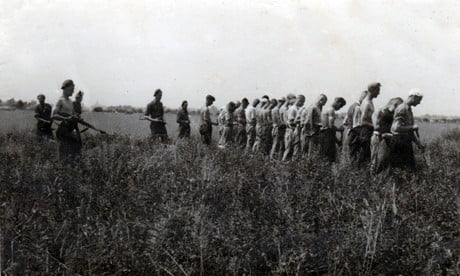
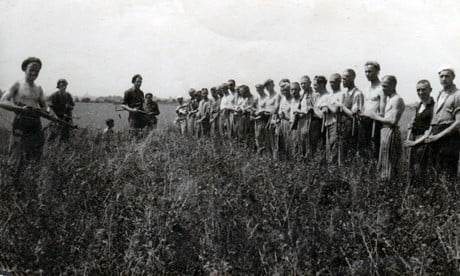
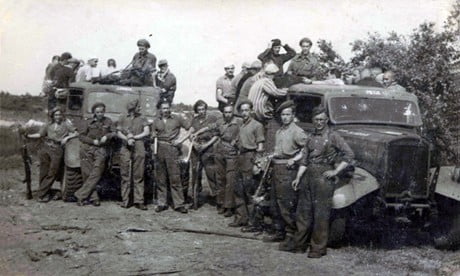
Dutch SS members from Camp Vucht carrying out mine detection, probably somewhere on the Schans in the Neerkant. They are being guarded by Dutch soldiers.

Below is a photograph of an S-mine, one of the many types of mines that were cleared in the Peel.
Sergeant Jean Dirven

View all persons in the category: Dutch Soldiers Killed in Action