


This memorial page is dedicated to Cornelius van Koolwijk, one of more than 725 war victims connected to the municipality of Deurne documented by Stichting Oorlogsslachtoffers. The municipality of Deurne and the surrounding villages of Liessel, Vlierden, Helenaveen, Neerkant and Zeilberg were liberated in the autumn of 1944 during heavy fighting. Victims fell on all sides: Allied soldiers from countries such as the United Kingdom, the United States, Canada and New Zealand, and German soldiers.
But the archive covers more than just the combat victims on Deurne soil. Residents of Deurne who lost their lives elsewhere are also commemorated: civilians who were murdered in concentration camps, forced labourers who died in Germany, people who were executed or succumbed to the effects of persecution and oppression. In addition, residents of Deurne who entered German military service and were killed elsewhere are also included.
Stichting Oorlogsslachtoffers has been documenting the story of all these people since 1995, without distinction of nationality, side or background. The goal is to give every person a name and a face, and to keep their memory alive.

| Name | : van Koolwijk | |
| First names | : Cornelius | |
| Nickname | : Cor | |
| Date of birth | : 1 May 1924 | |
| Place of birth | : Druten | |
| Residence | : Vriezeweg, ‘Hollandse Buurt’, Deest | |
| Rank / Occupation | : Brickworks labourer | |
| Identity tag | : – | |
| Unit | : Waffen SS | |
| Date of death | : 27 July 1945 | |
| Place of death | : Neerkant | |
| Cause of death | : as a result of a landmine explosion | |
| Cemetery | : Roman Catholic Cemetery in Deest | |
| Memorial site | : – | |
.
Additional information:
Son of Allard van Koolwijk and Maria van Zachten.
Cornelius van Koolwijk joined a Dutch barge on the Rhine in late 1942, where he worked as a deckhand. After returning home a few weeks later, he was conscripted to work in Germany, where he remained for almost two years. During his forced labour in Germany, he had not been granted leave to return to the Netherlands; consequently, in January 1945, Cornelius van Koolwijk decided to enlist as a volunteer in the Waffen-SS. Cornelius van Koolwijk had been told that Waffen-SS volunteers were being trained in the Netherlands, and because the war in the Netherlands had already reached such a stage, he had enlisted with the intention of deserting in the Netherlands. Following his detention and arrest on 30 May 1945, Cornelius van Koolwijk stated that he had not been wearing a uniform or carrying any weapons; after interrogation, he was interned at the ‘Lagero’ in Roosendaal, from where he was later transferred to the former concentration camp in Vught, where Germans, collaborators and war criminals were interned.
Due to the heavy fighting and during the Germans’ retreat and the Allied advance, a great deal of ammunition was left behind; consequently, it was possible that there was still a significant amount of unexploded ordnance in the ground. In the Neerkant area, there were also various ‘schrapnel mines’, or S-mines, which, once triggered, would leap into the air and explode at hip height, sending all manner of sharp pieces of steel flying in every direction.
There were so many mines in the Peel that it would take the small team of mine clearance experts years to clear them all. In Vught, Germans, collaborators and war criminals were interned in the former concentration camp, and because there were so many mines in the Peel, volunteers were sought there for the dangerous work in the Peel.
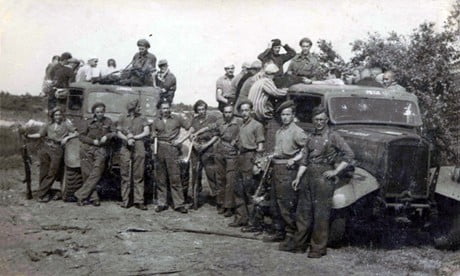
Cornelius van Koolwijk also volunteered and, after a short training course, he was taken from Vught to Deurne every day, along with other Dutch SS members, by camp guards from Camp Vught. Sergeant Jean Dirven, one of the leaders of the group of mine clearance workers, had nothing good to say about these guards. Jean Dirven discovered that, on the return journey in the evening, the camp guards would take their prisoners off the lorries in Helmond’s Markt and make them hop across the square and perform other gymnastic exercises for the amusement of onlookers. Furthermore, the SS men in the camp were beaten more often than they were fed; there were even instances where two of them fainted whilst clearing mines. Jean Dirven later learnt that the SS men were given a piece of bread in the morning and had to make that last the whole day, which is why they fainted from hunger. Jean Dirven managed to convince the mayor of Deurne that he could not continue working under such conditions, because if someone stepped on a mine at the wrong moment, several mine-clearers could die. From then on, Jean Dirven was able to collect half a loaf of bread for each mine clearer from Schiks’ bakery in Stationsstraat, at the expense of the municipality of Deurne.
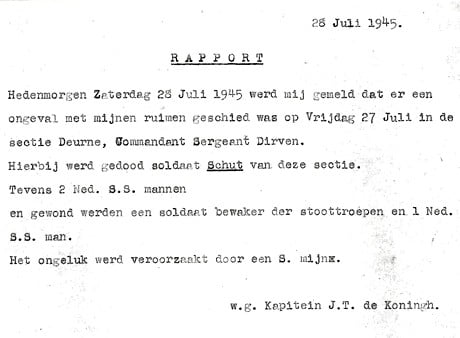
Normally, the mine clearance workers worked in pairs side by side, with the next pair following at a distance of about ten metres. Care was taken to ensure that they probed in an overlapping pattern. Behind Sjaak Mennen’s house, N108 in Neerkant, safety was momentarily neglected and the mine clearance workers were standing too close together in a small group. They are said to have been intending to pick fruit from the fruit trees when a mine was stepped on. Three SS men, including Cornelius van Koolwijk, Mathias Hubertus Verheijden and Antonius Johanne van Berkom, were killed in the incident. A Dutch soldier, Herman Schutte, a colleague of Jean Dirven, took a few more steps… said something and fell down dead. He had a small wound in the centre of his chest; a piece of shrapnel had struck him in the heart.

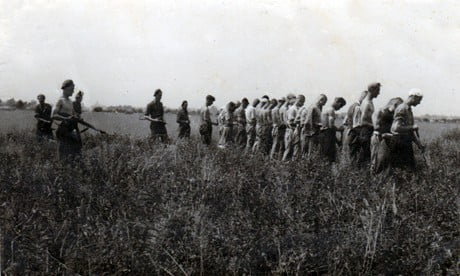
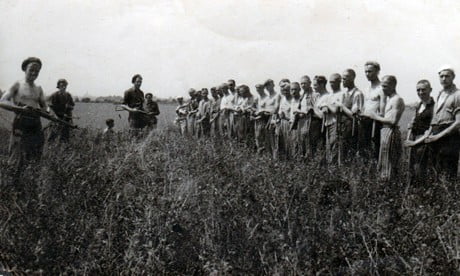
’s death register Dutch SS men from Camp Vucht clearing mines, probably somewhere on the Schans in the Neerkant. They are being guarded by Dutch soldiers.

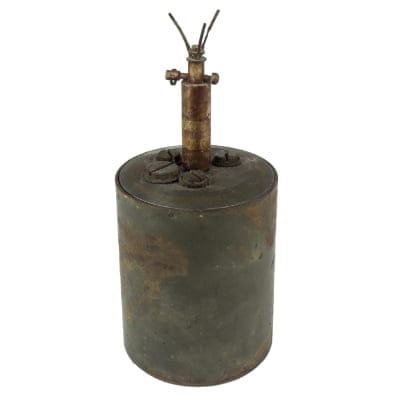
Below is a photograph of a Sprengmine. One of the many types of mines that were cleared in the Peel.
Report by Captain J.T. de Koningh
Sergeant Jean Dirven

View all persons in the category: German soldiers killed in action