


This memorial page is dedicated to Herman Schutte, one of more than 725 war victims connected to the municipality of Deurne documented by Stichting Oorlogsslachtoffers. The municipality of Deurne and the surrounding villages of Liessel, Vlierden, Helenaveen, Neerkant and Zeilberg were liberated in the autumn of 1944 during heavy fighting. Victims fell on all sides: Allied soldiers from countries such as the United Kingdom, the United States, Canada and New Zealand, and German soldiers.
But the archive covers more than just the combat victims on Deurne soil. Residents of Deurne who lost their lives elsewhere are also commemorated: civilians who were murdered in concentration camps, forced labourers who died in Germany, people who were executed or succumbed to the effects of persecution and oppression. In addition, residents of Deurne who entered German military service and were killed elsewhere are also included.
Stichting Oorlogsslachtoffers has been documenting the story of all these people since 1995, without distinction of nationality, side or background. The goal is to give every person a name and a face, and to keep their memory alive.

| Name | : Schutte | |
| First names | : Herman | |
| Nickname | : Herman | |
| Date of birth | : 28 August 1921 | |
| Place of birth | : Apeldoorn | |
| Residence | : in Apeldoorn | |
| Rank / Occupation | : Soldier / Mechanic | |
| Identity tag | : – | |
| Unit | : 1st Netherlands Bomb Disposal Company, Section 15 | |
| Date of death | : 27 July 1945 | |
| Place of death | : Neerkant | |
| Cause of death | : as a result of a landmine explosion | |
| Cemetery | : – | |
| Memorial site | : Memorial to Mine and Ordnance Clearers | |
Additional information:
Son of Hendrik Schutte and Martha Hulleman.
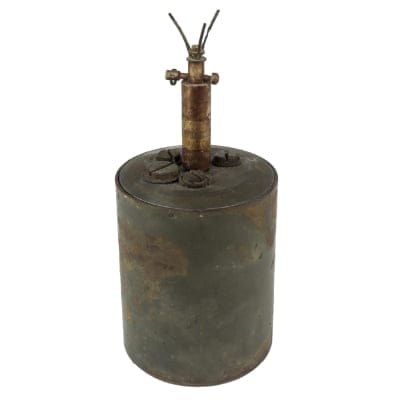
Due to the heavy fighting and during the German retreat and the Allied advance, a great deal of ammunition was left behind; consequently, it was possible that there was still a significant amount of unexploded ordnance in the ground. In the Neerkant area, there were also various ‘schrapnell mines’, or S-mines, which, once triggered, would leap into the air and explode at hip height, sending all manner of sharp pieces of steel flying in every direction.
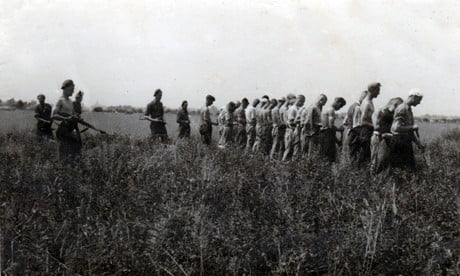
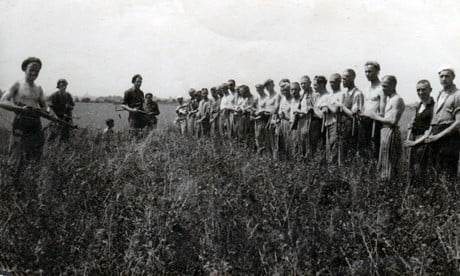
There were so many mines in the Peel that the small group of mine clearance experts, including Private Herman Schutte, would need years to clear them all. In Vught, Germans, collaborators and war criminals were interned in the former concentration camp, and because there were so many mines in the Peel, volunteers were sought there for the dangerous work in the Peel.
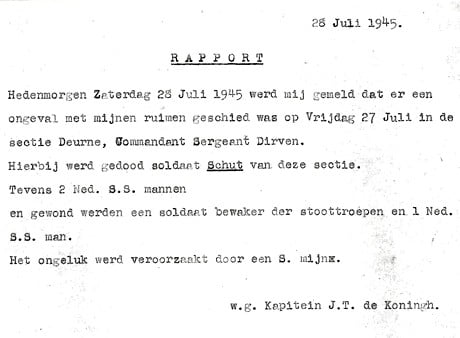
Behind Sjaak Mennen’s house (N108) in Neerkant, safety was momentarily overlooked, and a small group found themselves standing too close together. They are said to have been planning to pick fruit from the fruit trees when one of them stepped on a mine. Three Dutch SS men – Cornelius van Koolwijk, Antonius Johanne van Berkom and Mathias Hubertus Verheijden – were killed in the incident, and at first glance it seemed as though Private Herman Schutte was unharmed; he took a few more steps, said something and then collapsed, dead. He had a small wound in the centre of his chest; the shrapnel had struck his heart.
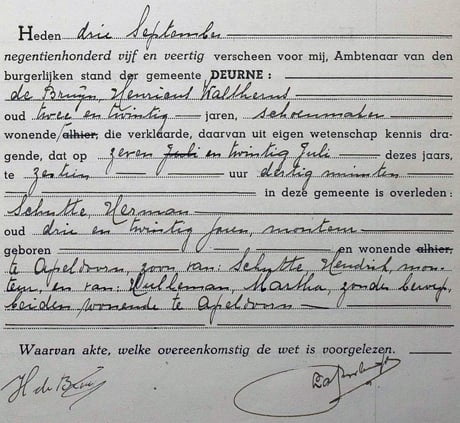
’s death register Dutch SS men from Camp Vucht clearing mines, probably somewhere on the Schans in the Neerkant. They are being guarded by Dutch soldiers.

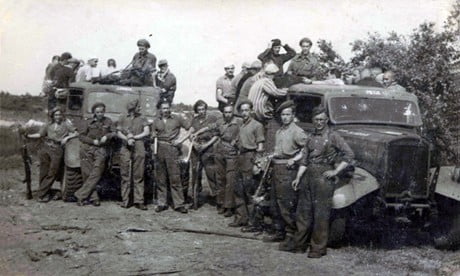
Below is a photograph of an explosive mine. One of the many types of mines that were cleared in the Peel.
Report by Captain J.T. de Koningh
Sergeant Jean Dirven

View all persons in the category: Dutch Soldiers Killed in Action